


Key Takeaways
- Dubai’s logistics volume has outgrown legacy, disconnected systems — causing delays, inventory errors, and higher costs.
- Customers now expect prediction, not just tracking — that’s the real shift driving demand for smarter platforms.
- Custom software fits UAE-specific needs (customs, GCC cross-border, Arabic/English UX) better than generic tools.
- Enterprise platforms combine modules — TMS, WMS, Fleet, Last-Mile, Freight, and a Control Tower for unified visibility.
- AI (route optimization, predictive maintenance, demand forecasting, document automation) is now a core ROI driver.
- Must-have features: real-time tracking, cloud architecture, API integrations, mobile apps, dashboards, and security.
- Impact: better visibility, faster decisions, less manual work, stronger customer experience, and more resilience.
- Development follows a clear process — requirements, architecture, design, build, deploy, and ongoing optimization.
- Custom vs. off-the-shelf: off-the-shelf suits smaller ops; custom pays off at enterprise scale.
- Cost depends on scope (modules, integrations, AI, mobile) — there’s no fixed price.
- Choose a dev partner based on UAE experience, integration skill, and security — not just cost.
Dubai moves more cargo through its ports and airports than most countries move in a year. Jebel Ali alone handles over 15 million TEUs annually, and DXB remains one of the busiest cargo airports on the planet. That volume used to be a logistics advantage on its own. It isn’t anymore.
Enterprises running regional and cross-border operations out of the UAE are discovering that scale without visibility is just chaos with a bigger budget. A shipment delayed in Jebel Ali, a warehouse miscount in Dubai South, a customs hold at the border — each one used to be handled by a phone call and a spreadsheet. That doesn’t work at enterprise volume anymore, and it definitely doesn’t work when customers expect Amazon-level tracking on a B2B freight order.
This is why custom logistics software development in Dubai has moved from “nice to have” to board-level priority for mid-size and large logistics operators. The city’s position as a global trade hub means supply chains here touch more borders, more carriers, and more regulatory checkpoints than almost anywhere else. Add growing eCommerce volume, tighter delivery windows, and customers who now expect real-time answers instead of “we’ll check and get back to you,” and the pressure on legacy systems becomes obvious fast.
Here’s the shift worth understanding before anything else: modern logistics companies don’t need another tracking dashboard. They already have three of those, and none of them talk to each other. What they need is a connected platform that predicts problems before they happen, automates the manual work eating up staff hours, and gives leadership actual control over an operation that’s grown too complex for spreadsheets and disconnected tools.
This guide walks through what that looks like in practice — from the core modules enterprise logistics platforms need, to how AI is changing route planning and maintenance, to what it actually costs to build one of these systems in the UAE market.
Understanding the Digital Supply Chain Transformation in Dubai
Logistics technology adoption in the UAE has accelerated for reasons that have nothing to do with hype cycles. eCommerce growth across the GCC has pushed delivery volumes up year over year, and international trade through Dubai’s ports keeps expanding as the emirate positions itself as the connector between Asia, Africa, and Europe. Every one of those trend lines adds pressure to systems that were built for a smaller, slower version of the same business. As supply chains become more interconnected, businesses also need better coordination between warehouses, transport networks, suppliers, and customers to keep operations running efficiently.
Customer expectations have changed just as fast. A retail customer waiting on a same-day delivery and a manufacturing client tracking a container of raw materials both want the same thing now: a straight answer, updated in real time, without having to call anyone. Operations teams feel this pressure daily. Sales feels it when a delayed shipment turns into a lost contract renewal. For enterprise logistics companies, even small delays can affect customer satisfaction, operational costs, and long-term business relationships.
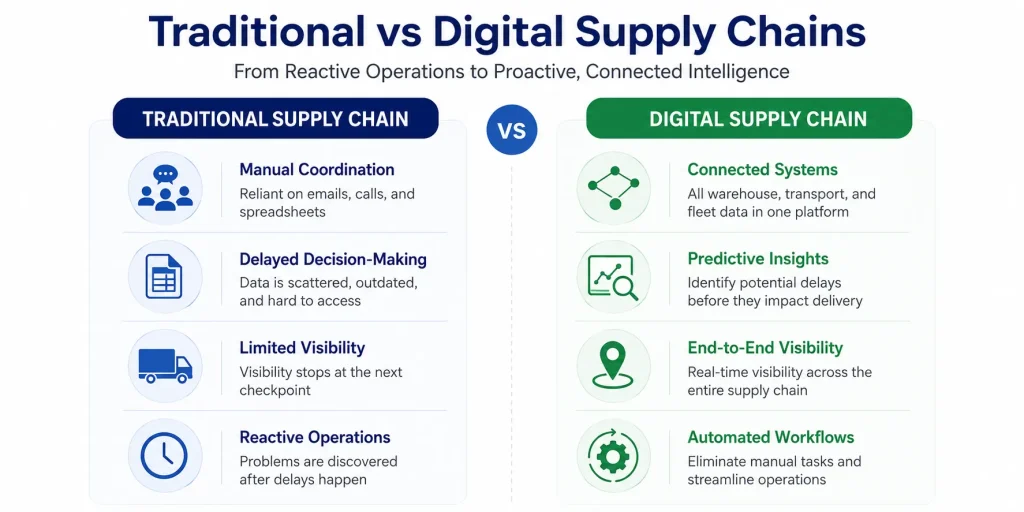
The difference between traditional and digital supply chains comes down to three things.
Traditional logistics operations rely on:
- Manual coordination between warehouses, carriers, and customer service teams
- Delayed decision-making because data sits in disconnected spreadsheets and emails
- Limited visibility past the next checkpoint — nobody can see the whole chain at once
Digital supply chains, by contrast, run on:
- Connected systems where warehouse, transport, and fleet data live in one place
- Predictive insights that flag a likely delay before it becomes a missed delivery
- Automated workflows that remove the manual re-keying of data between systems
This isn’t a cosmetic upgrade. It’s the difference between an operations manager reacting to problems after customers complain, and a system that surfaces the problem three hours before it happens. It also gives businesses the visibility needed to make faster operational decisions and respond to disruptions with greater confidence. That gap is exactly why logistics software development in Dubai has become a genuine competitive lever rather than a back-office IT project.
Why Traditional Logistics Systems Are Not Enough for Modern Enterprises
Most enterprise logistics operations in the region aren’t running on one system. They’re running on four or five — a TMS from one vendor, a WMS from another, fleet tracking bolted on separately, and a customer portal that was built years ago and never updated. Each one works fine in isolation. Together, they create exactly the kind of fragmentation that quietly drains margin. As businesses expand across multiple warehouses, transport partners, and distribution channels, this fragmented technology landscape becomes even harder to manage. Instead of enabling growth, disconnected systems often create operational bottlenecks that slow it down.
Fragmented Supply Chain Operations
When systems don’t talk to each other, someone has to. That usually means a staff member manually re-entering shipment data from the TMS into the WMS, or exporting a spreadsheet from the fleet system to email to the ops team every morning. Multiple disconnected systems mean multiple sources of truth, and multiple sources of truth mean nobody actually knows the real status of anything without checking three places first. There’s no centralized visibility — just a collection of partial pictures that someone has to stitch together manually, usually under time pressure. The larger the logistics operation becomes, the more difficult it is to maintain consistency across departments. Even a small data mismatch can affect inventory planning, transportation schedules, and customer commitments.
Operational Challenges Caused by Legacy Systems
This fragmentation shows up as real, measurable business damage:
- Shipment delays because exceptions aren’t flagged until a customer calls asking where their order is
- Inventory inaccuracies between what the WMS says is in stock and what’s physically on the shelf
- Higher operational costs from manual labor spent reconciling data that should sync automatically
- Poor customer communication because support teams are working from outdated or incomplete information
Over time, these issues don’t just affect daily operations—they reduce overall supply chain efficiency and make it harder for businesses to scale confidently. As shipment volumes increase, manual coordination becomes increasingly unsustainable.
None of these are exotic problems. They’re the everyday friction that logistics operators in Dubai have learned to work around — which is exactly the trap. Working around a broken process for long enough makes it feel normal, right up until a competitor with better systems starts winning contracts on service reliability alone.
Why Businesses Need More Than Shipment Tracking
The bar has moved. Five years ago, “where is my shipment” was a reasonable question with a reasonable answer: check the tracking number. Today, that question isn’t enough — for the customer or for the business running the operation. The real question enterprises are asking now is whether the system can predict a delay before it happens and recommend the best next move, rather than just reporting what already went wrong. Modern logistics leaders also want greater visibility into inventory, fleet performance, warehouse operations, and customer commitments from a single platform rather than switching between multiple applications.
That’s the line separating a tracking tool from an actual logistics platform, and it’s one of the Operational bottlenecks in Dubai logistics that custom software is specifically built to solve. This shift is one of the biggest reasons enterprises are increasingly investing in custom logistics software development in Dubai to build connected, scalable, and data-driven supply chain operations.
What Is Custom Logistics Software Development and Why Does It Matter?
Custom logistics software is a platform built around how a specific company actually operates — its warehouses, its carrier relationships, its customs workflows, its customer commitments — rather than a generic set of features every buyer gets regardless of fit.
The difference from an off-the-shelf platform isn’t cosmetic. Generic platforms are built to serve the widest possible market, which means every feature is a compromise designed to be “good enough” for most users. A custom-built enterprise solution starts from the opposite direction: what does this business need, specifically, to run better than it does today? That question changes everything from the database schema to the user interface.
For businesses operating in the UAE, this matters more than it would elsewhere. Dubai logistics companies deal with a mix of local, GCC, and international shipments simultaneously, each with different documentation requirements, different customs processes, and often different languages for staff and customers. A rigid, one-size-fits-all platform forces the business to adapt its operations to the software’s limitations. Custom logistics software development in Dubai flips that relationship — the software adapts to the business, not the other way around.
That flexibility is also what makes custom platforms scale well. As a company adds new branches, new carriers, or new markets, a custom system can be extended to match. A generic platform usually can’t — you hit the ceiling of what the vendor’s roadmap supports, and then you’re stuck waiting for a feature request to get prioritized against every other customer’s wish list.
Essential Components of Enterprise Logistics Software Solutions
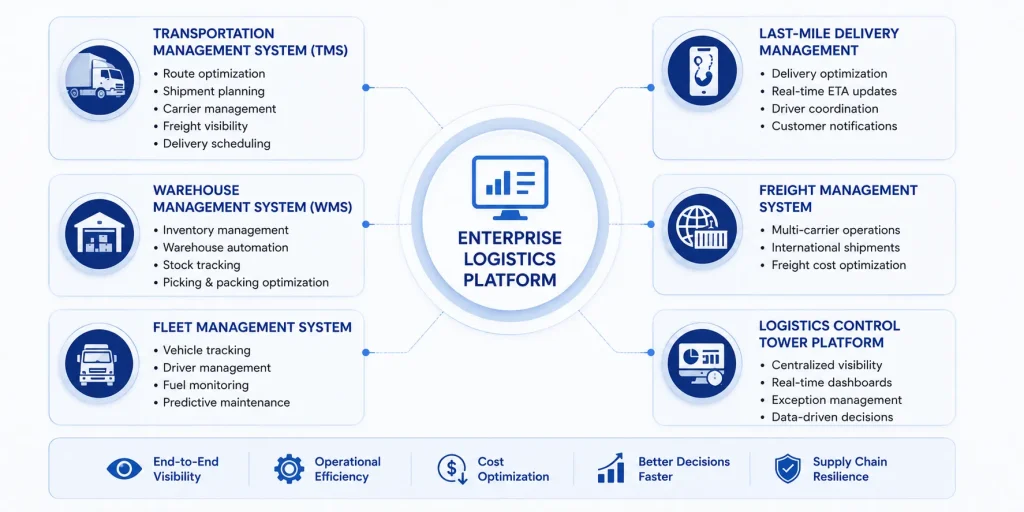
An enterprise logistics platform isn’t one piece of software — it’s a set of connected modules, each solving a specific operational problem, all feeding the same central data layer. Here’s what the core stack actually looks like. While every logistics business has unique operational requirements, these modules form the foundation of most enterprise-grade platforms. Together, they help organizations improve visibility, streamline workflows, and make faster operational decisions across the supply chain.
Transportation Management System (TMS)
The TMS is the operational backbone for moving goods from point A to point B efficiently. It helps businesses plan, execute, and monitor transportation activities while improving delivery performance and reducing transportation costs. A well-built TMS handles:
- Route optimization that factors in traffic patterns, delivery windows, and vehicle capacity
- Shipment planning that consolidates loads to reduce cost per delivery
- Carrier management across multiple transport partners, with performance tracking built in
- Freight visibility so ops teams can see exactly where every shipment sits at any moment
- Delivery scheduling that adjusts automatically when conditions change
Warehouse Management System (WMS)
Warehouses are where inventory accuracy either holds together or falls apart. As order volumes increase, businesses need better control over inventory movement and warehouse operations to avoid costly errors and delays. A modern WMS covers:
- Inventory management with real-time stock counts instead of end-of-day reconciliation
- Warehouse automation for repetitive tasks like putaway and replenishment
- Stock tracking down to the SKU and location level
- Picking and packing optimization that reduces the walking time and error rate for warehouse staff
Fleet Management System
For companies running their own vehicle fleets, this module is where operational cost control actually happens. Beyond simply tracking vehicles, it helps logistics teams improve asset utilization, monitor driver performance, and reduce unexpected operational disruptions. This module includes:
- Vehicle tracking across the entire fleet in real time
- Driver management covering schedules, performance, and compliance
- Fuel monitoring to catch waste and unauthorized use early
- Predictive maintenance that flags a vehicle issue before it causes a breakdown mid-route
Last-Mile Delivery Management
Last mile is where most customer-facing frustration lives, and it’s also the most expensive leg of the delivery journey. Since this stage has the greatest impact on customer experience, businesses increasingly rely on intelligent delivery management tools to improve speed and communication. This module handles:
- Delivery optimization that sequences stops for minimum travel time
- Real-time ETA updates pushed directly to customers
- Driver coordination through mobile apps rather than radio calls
- Customer notifications that reduce “where is my order” support tickets
Freight Management System
For enterprises handling multi-carrier or international freight, this module manages the complexity of domestic and cross-border transportation while improving shipment planning and cost efficiency. It includes:
- Multi-carrier operations with rate comparison and automated carrier selection
- International shipments including documentation and customs coordination
- Freight cost optimization by consolidating volume and negotiating from actual usage data
Logistics Control Tower Platform
This is the layer that ties everything together — the single view that lets leadership actually see the whole operation instead of five separate ones. Rather than switching between multiple systems, operations teams can monitor logistics performance, identify issues quickly, and make informed decisions from one centralized platform. It provides:
- Centralized operational visibility across TMS, WMS, fleet, and freight data
- Real-time dashboards built for both operations staff and executives
- Exception management that surfaces problems the moment they occur, not after a customer complains
- Data-driven decisions backed by actual operational data instead of gut feel
Put together, these modules form what most operators mean when they refer to true UAE logistics digital transformation — not a single app, but a connected operating system for the entire supply chain. As businesses continue to scale, these systems become even more valuable by creating a single source of truth across logistics operations, enabling better collaboration, faster decision-making, and greater supply chain resilience.
How AI Is Transforming Logistics Software Development in Dubai
AI in logistics isn’t a buzzword feature anymore — it’s become one of the clearest ROI drivers in enterprise supply chain software, and Dubai’s logistics companies are adopting it faster than most because the traffic patterns, weather variability, and cross-border complexity here make manual planning genuinely hard to do well.
AI-Based Route Optimization
Traditional route planning uses static distance calculations. AI-based route optimization factors in live traffic prediction, historical delivery patterns, and real-world conditions to plan routes that actually hold up once a driver is on the road. The result is measurable: better delivery efficiency, fewer late arrivals, and meaningful fuel reduction across a fleet running hundreds of routes a day.
Predictive Analytics for Supply Chain Planning
This is where AI moves from reactive to genuinely useful. Predictive analytics in logistics uses historical and real-time data to forecast demand before it spikes, plan warehouse and fleet capacity ahead of need, and flag risk — a likely customs delay, a carrier capacity shortage, a seasonal demand surge — before it disrupts operations. Companies using this well aren’t predicting the future perfectly; they’re just seeing problems two or three days earlier than they used to, which is often enough time to actually do something about them.
Machine Learning-Based Predictive Maintenance
For fleet-heavy operations, unplanned vehicle downtime is one of the most expensive line items nobody budgets for properly. Machine learning models trained on vehicle sensor data can flag vehicle failure risk before a breakdown happens, which directly reduces downtime and improves asset utilization across the fleet. Instead of reactive repairs after a truck fails mid-delivery, maintenance gets scheduled proactively, during planned downtime, at a fraction of the cost. It’s one of the clearest AI use cases in logistics precisely because the ROI is so easy to measure — fewer breakdowns, less downtime, lower repair bills.
AI-Powered Document and Compliance Automation
UAE logistics operations generate a heavy volume of documentation — customs declarations, bills of lading, compliance certificates — and manual processing of this paperwork is slow and error-prone by nature. AI-powered document automation handles automated document processing, catches errors before they cause customs delays, and speeds up approvals that used to take days down to hours. This is a meaningful part of what makes modern supply chain software development UAE projects worth the investment: the compliance layer alone can eliminate entire job functions built around manual paperwork chasing.
Dubai-Specific Requirements for Enterprise Logistics Software
Generic logistics platforms — the kind built for the US or European market and sold globally — tend to fall short in the UAE for reasons that have nothing to do with feature depth. They’re missing the regional context that Dubai operations actually run on.
UAE Customs and Compliance Integration
Import and export documentation in the UAE follows specific workflows tied to Dubai Customs and federal trade regulations. Enterprise logistics software needs to handle documentation workflows natively, track import/export requirements by shipment type, and maintain compliance tracking that flags issues before goods reach the border — not after a shipment gets held up and a client is calling asking why.
Arabic and English User Experience
A platform used by warehouse staff, drivers, customer service teams, and executives across the UAE needs to work fluently in both Arabic and English. This isn’t a translation checkbox — it means multilingual interfaces built from the ground up, not bolted on later, and regional usability that reflects how teams here actually work, not how a US-built platform assumes they do.
GCC Cross-Border Logistics Support
Dubai isn’t an isolated market — it’s a hub connecting to Saudi Arabia, Oman, Bahrain, Qatar, and Kuwait. Enterprise platforms need built-in support for regional transportation workflows that account for GCC border processes, plus the ability to manage multi-location operations across several countries from a single system rather than juggling separate tools per market. For companies running warehouses and fleets across multiple emirates or GCC countries, this is really what a multi-branch logistics platform needs to deliver — one system, one source of truth, regardless of how many locations feed into it.
Integration With Local Logistics Ecosystem
No logistics platform operates in a vacuum. It needs to connect cleanly with the partners, warehouses, and carriers already embedded in a company’s operations, plus whatever enterprise systems — ERP, accounting, CRM — already run the business. This is the practical core of any logistics software UAE guide worth following: the software has to fit into an existing operational ecosystem, not force a company to rebuild its partner network around a new tool.
Must-Have Features in Logistics Software Platforms for 2026
Regardless of which modules a company prioritizes first, certain logistics software features have become non-negotiable for any platform built for enterprise use this year.
- Real-time tracking and visibility across every leg of the supply chain, not just the final delivery
- Cloud-based architecture that scales without a hardware refresh every few years
- API-based integrations so the platform connects with ERPs, carriers, and customs systems without custom point-to-point work every time
- Mobile applications for drivers, warehouse staff, and field teams who aren’t sitting at a desk
- Analytics dashboards that turn raw operational data into decisions leadership can actually act on
- Automated alerts and notifications that flag exceptions the moment they happen, not during a weekly review
- Customer portals that let clients self-serve tracking and documentation instead of calling support
- Security and access management with role-based permissions across every user type in the system
Skip any one of these and the platform ends up with a gap that eventually becomes a workaround, and workarounds are exactly what got most companies into fragmented-systems trouble in the first place.
How Custom Logistics Software Improves Supply Chain Performance
The features matter less than what they actually produce for the business. Here’s what changes on the ground when a custom platform replaces a fragmented legacy setup.
Better Operational Visibility
When TMS, WMS, and fleet data live in one place, an ops manager can see the real status of an entire shipment lifecycle without opening four different tools. That alone eliminates a huge chunk of the daily “let me check and get back to you” delay. With a single source of truth, every department works from the same real-time information, reducing confusion and improving collaboration.
Faster Decision-Making
A logistics control tower that flags a capacity shortfall two days out lets a team reroute or reassign before it becomes a missed delivery, rather than explaining after the fact why something went wrong. This allows operations teams to act proactively instead of reacting after a disruption has already affected customers.
Reduced Manual Processes
Every hour a staff member spends re-keying data between disconnected systems is an hour not spent on actual problem-solving. Automating that data flow is often where custom software pays for itself fastest. It also minimizes human errors and enables employees to focus on higher-value operational tasks.
Improved Customer Experience
Real-time ETAs, proactive delay notifications, and self-service portals change the entire tone of the customer relationship — from “checking in anxiously” to “trusting the system to tell them.” Greater transparency builds customer confidence and strengthens long-term business relationships.
Higher Supply Chain Resilience
A mid-size UAE distribution company running a control tower platform can absorb a customs delay or a carrier disruption without it cascading into missed commitments across every downstream order, because the exception gets flagged and rerouted before it compounds. That’s the practical difference between a resilient supply chain and a fragile one — it’s not about avoiding disruption, it’s about how fast the system responds when disruption happens. This level of agility helps businesses maintain service quality even during periods of unexpected operational disruption.
Together, this is how logistics software improve supply chain efficiency in measurable terms, not abstract ones — fewer delays, lower cost per shipment, and a support team that spends less time firefighting.
Custom Logistics Software Development Process: From Planning to Deployment
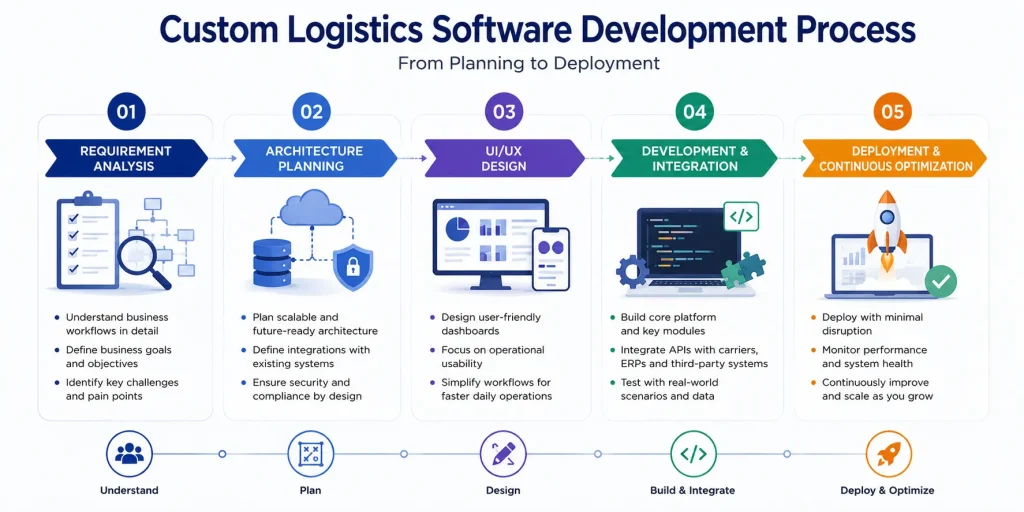
Building enterprise logistics software isn’t a single project phase — it’s a structured process, and skipping steps early is the single most common reason custom builds underdeliver.
Requirement Analysis
Everything starts with understanding the actual business, not the software category. This means mapping existing logistics workflows in detail, clarifying the business goals the platform needs to support, and identifying the operational challenges causing the most pain right now. A rushed requirement phase is the root cause behind most of the logistics software implementation mistakes enterprises run into later.
Architecture Planning
Before a single screen gets designed, the technical foundation needs to be right. This covers scalability — can the system handle 10x the current shipment volume without a rebuild — integrations with existing enterprise tools, and security from day one, not bolted on after launch.
UI/UX Design
Logistics software gets used by people under time pressure — a warehouse worker mid-shift, a dispatcher managing twenty drivers at once. Design needs to prioritize user-friendly dashboards and genuine operational usability over visual polish. A beautiful interface that takes six clicks to log a delivery exception is a failed interface.
Development and Integration
This is where the platform actually gets built — APIs connecting to carriers and ERPs, third-party systems synced with the core platform, and testing that covers real operational scenarios, not just clean happy-path demos. This phase is the technical heart of any logistics software integration architecture, and it’s where most of the development timeline actually gets spent.
Deployment and Continuous Optimization
Launch isn’t the finish line. Enterprise logistics platforms need ongoing monitoring to catch issues before users report them, continuous improvements based on real usage patterns, and scaling plans as the business — and the shipment volume — grows. Companies that treat deployment as “done” tend to be back at square one within two years, which is exactly why a proper logistics software development roadmap treats post-launch as its own ongoing phase, not an afterthought.
Custom Logistics Software vs Off-the-Shelf Solutions
This is the decision every enterprise logistics buyer eventually has to make, and there’s no universally correct answer — it depends on where the business actually is. The right choice depends on factors such as operational complexity, business growth plans, integration requirements, and the level of flexibility needed over the long term. While both approaches have their place, understanding their strengths and limitations helps enterprises make a more informed investment decision, especially when evaluating solutions like a real-time transportation visibility platform for improving operational transparency and scalability.
Ready-Made Logistics Platforms
Advantages:
- Faster implementation, often live within weeks
- Standard features that cover common logistics needs out of the box
For startups or businesses with relatively simple logistics operations, these platforms can provide a quick way to digitize everyday processes without significant upfront development effort.
Limitations:
- Customization restrictions that force operations to adapt to the software instead of the reverse
- Integration challenges when connecting to region-specific systems or unusual partner setups
As operations become more complex, businesses often discover that standard platforms cannot easily accommodate unique workflows, evolving customer requirements, or specialized compliance processes.
Custom Enterprise Logistics Platforms
Advantages:
- Tailored workflows that match exactly how the business operates, not a generic approximation of it
- Scalability that grows with the company instead of hitting a vendor-imposed ceiling
- Competitive differentiation — a system built around proprietary processes competitors can’t easily replicate
Custom platforms also make it easier to integrate with ERP systems, warehouse solutions, carrier networks, customer portals, and other enterprise applications, creating a single connected logistics ecosystem.
The honest framing on custom vs off-the-shelf logistics software: an off-the-shelf platform makes sense for a smaller operation still validating its processes. Once a company hits enterprise scale — multiple branches, complex integrations, region-specific compliance needs — the limitations of generic software start costing more than a custom build would have. For many growing businesses in the UAE, investing in custom logistics software becomes less about adding features and more about building a technology foundation that supports long-term operational efficiency and sustainable growth.
Cost Factors Affecting Logistics Software Development in Dubai
There’s no honest fixed number here, and any vendor quoting one without understanding the scope first should be a red flag. What actually drives the cost of logistics software in the UAE market comes down to a handful of variables:
- Number of modules — a TMS-only build costs a fraction of a full TMS + WMS + fleet + control tower platform
- Software complexity — the depth of business logic, workflow variations, and edge cases the system needs to handle
- Integrations — how many external systems (ERP, customs, carrier APIs) the platform needs to connect with, and how clean those integrations already are
- AI capabilities — predictive analytics and route optimization add real development time but also tend to carry the strongest ROI
- Mobile apps — dedicated driver and field apps versus a responsive web interface
- Cloud infrastructure — hosting, data storage, and scaling costs that continue past the initial build
- Maintenance requirements — ongoing support, updates, and optimization after launch, which is a recurring cost, not a one-time line item
Any serious vendor conversation should start with a scoping exercise before a price ever gets discussed. If it doesn’t, that’s usually a sign the estimate isn’t grounded in the actual complexity of the business.
Future of Digital Supply Chains in Dubai
The direction of travel here isn’t subtle. Dubai’s logistics sector is moving toward intelligent automation where more decisions — routing, inventory replenishment, exception handling — happen without a human triggering each one manually. Advanced analytics is shifting from “what happened last month” reporting toward genuinely predictive planning that anticipates demand and disruption before they hit.
Connected logistics ecosystems are becoming the norm rather than the exception, with warehouses, carriers, customs systems, and enterprise platforms increasingly expected to share data in real time instead of through manual exports. Cloud-based supply chain platforms make this possible at a cost and speed that on-premise infrastructure never could, which is part of why cloud-based logistics software has become close to a default assumption for new enterprise builds rather than a differentiator.
Underneath all of it is a single shift: data-driven decision making replacing experience-based gut calls. That’s not a knock on experienced operators — it’s an acknowledgment that supply chains have gotten too complex, too fast, for even the best operator to hold the whole picture in their head. The companies investing now in the systems to capture and act on that data are the ones setting themselves up to lead the next phase of this shift, not react to it.
How to Choose the Right Logistics Software Development Partner in Dubai
Picking a development partner for a system this central to operations is not a decision to make on price alone. A few things matter more than a slick sales deck. The right partner should understand both enterprise software development and real-world logistics operations. Industry experience. A partner who’s built logistics software before understands the operational nuances — exception handling, multi-leg shipment tracking, carrier integrations — that a generalist software vendor will learn the hard way, on your project. Technical expertise. The team needs real depth in the technologies that make enterprise logistics software work: cloud architecture, API design, and increasingly, applied AI and machine learning for the predictive features that separate a modern platform from a glorified spreadsheet.
Understanding of UAE logistics operations. This is the piece generic vendors consistently miss — UAE customs workflows, GCC cross-border requirements, and the bilingual operational reality of running teams across the region. Integration capabilities. The partner should be able to connect the new platform cleanly to existing ERP, accounting, and carrier systems, not treat every integration as a custom research project that blows the timeline. Seamless integration is essential for maintaining operational visibility and reducing manual work.
Security practices. Given the volume of shipment, customer, and financial data flowing through a logistics platform, data security in logistics software needs to be a first-class requirement, not a feature added late in development. Post-launch support. A logistics platform is never really “finished” — it needs continuous monitoring, updates, and optimization as the business grows and operational needs shift. This checklist matters most for enterprises weighing a genuinely custom build, and it’s the practical foundation behind any serious enterprise logistics software dubai guide — the technology only delivers if the partner building it actually understands the operational reality it needs to run inside.
Why Enterprises Should Invest in Custom Logistics Software Development in Dubai
The case for custom logistics software isn’t about chasing the newest technology — it’s about closing the gap between what a business’s operations actually need and what generic tools were ever built to provide.
Custom platforms give enterprises better control over their own data and workflows instead of working within someone else’s product roadmap. They deliver higher efficiency by automating the manual work that quietly eats into margin every single day. They provide improved scalability, so growth into a new branch, a new market, or a new service line doesn’t mean waiting on a vendor’s next release cycle. And they create genuine competitive advantage — a system built around how a company actually operates is something a competitor running an off-the-shelf platform simply can’t replicate.
For UAE logistics enterprises serious about staying ahead over the next few years rather than just keeping up, custom software isn’t a discretionary IT spend. It’s infrastructure. If your operation is still running on disconnected systems and reactive firefighting, the conversation worth having now is what a platform built specifically around your workflows could look like — and what it would be worth in delays avoided, hours saved, and customers kept.
Conclusion
Dubai’s logistics industry isn’t heading toward digital transformation — it’s already well into it, and the enterprises still running on fragmented, disconnected systems are the ones feeling the cost most acutely, whether that shows up as missed deliveries, frustrated customers, or margin quietly eaten by manual work.
What separates the operators pulling ahead isn’t more tools. It’s a connected digital supply chain — one platform giving real visibility across transportation, warehousing, fleet, and freight, instead of five tools that each show a partial picture.
Custom logistics software is what makes that possible. It’s not about chasing a trend; it’s about building the infrastructure to predict problems before they cost money, automate the work that shouldn’t need a human doing it manually, and give a business real control over an operation that’s grown too complex for spreadsheets. For enterprises serious about competing in Dubai’s logistics market over the next several years, that infrastructure isn’t optional anymore — it’s the foundation everything else gets built on.
Frequently Asked Questions
What is custom logistics software development in Dubai?
It’s the process of building a logistics management platform designed specifically around a company’s own operations, workflows, and regional requirements — rather than deploying a generic, one-size-fits-all system.
How does logistics software improve supply chain operations?
By connecting previously siloed systems — transportation, warehouse, fleet, and freight data — into one platform, giving operations teams real-time visibility, automating manual data entry, and using predictive analytics to catch problems before they disrupt deliveries.
What features should enterprise logistics software include?
At minimum: real-time tracking, cloud-based architecture, API integrations, mobile apps for field teams, analytics dashboards, automated alerts, customer self-service portals, and role-based security access.
How much does logistics software development cost in Dubai?
It depends entirely on scope — the number of modules, integration complexity, AI capabilities, and mobile app requirements all affect cost significantly. There’s no honest flat number without a proper scoping conversation first.
How long does it take to build logistics software?
Timelines vary by scope, but a mid-complexity enterprise platform with core TMS/WMS modules typically takes several months from requirement analysis through deployment, with continuous optimization continuing well past launch.
Can custom logistics software integrate with ERP and warehouse systems?
Yes — this is one of the core advantages of a custom build. Unlike many off-the-shelf platforms, custom software is designed from the start to connect cleanly with existing ERP, accounting, and warehouse systems already in use.