


Logistics technology stopped being a back-office line item a while ago. It’s now one of the few decisions that can quietly decide whether a company scales smoothly or spends the next three years fighting its own systems. Global spend on logistics software keeps climbing every year, yet a surprising number of enterprises still miss their expected ROI — not because the software is bad, but because it doesn’t fit how they actually work.
That mismatch shows up fastest in places with layered operational complexity. Dubai and the wider UAE are a good example: free zones, cross-border trade through Jebel Ali, multilingual teams, and customers who now expect Amazon-level visibility on a container shipment. Generic platforms weren’t built with that stack of requirements in mind.
So the question enterprises keep circling back to — custom logistics software vs off-the-shelf — doesn’t have a single right answer. It depends on how complex your operations are, how fast you’re growing, and how much of your competitive edge actually lives inside your workflows. This guide walks through both paths so you can figure out which one (or which combination) fits your business.
Key Takeaways
- No universal winner – the “custom vs off-the-shelf” debate depends on operational complexity and growth stage, not company size.
- Off-the-shelf wins on speed and cost upfront – live in 4–8 weeks, lower initial investment, vendor-managed compliance and support.
- Off-the-shelf hits a ceiling at scale – limited customization, vendor lock-in, integration gaps, and licensing costs that grow with usage.
- UAE/GCC operations expose that ceiling faster – free-zone rules (JAFZA, Dubai South, DAFZA), Jebel Ali port workflows, cold-chain needs, and bilingual Arabic-English requirements are rarely handled natively by generic platforms.
- Custom software costs more upfront but flattens long-term – no recurring per-seat licensing, full data ownership, and workflows built around your actual operations.
- Custom is the better fit when: you operate across multiple countries, need custom pricing models, want AI-driven automation, or your workflows are a competitive differentiator.
- Buy is the better fit when: operations are standard, IT resources are lean, and you need something running fast.
- Hybrid is the practical default for most enterprises – buy the core TMS/WMS, build the differentiating layers (customer portals, analytics, AI, automation, niche integrations).
- AI-readiness depends on data architecture – custom systems are easier to align with AI use cases since off-the-shelf platforms are built around average, not proprietary, data.
- Evaluate for adaptability, not just today’s needs – with AI-native platforms, predictive visibility, and IoT-driven intelligence accelerating, future-proofing matters more than short-term implementation cost.
- The real question to ask: is your current logistics platform supporting your growth, or quietly capping it?
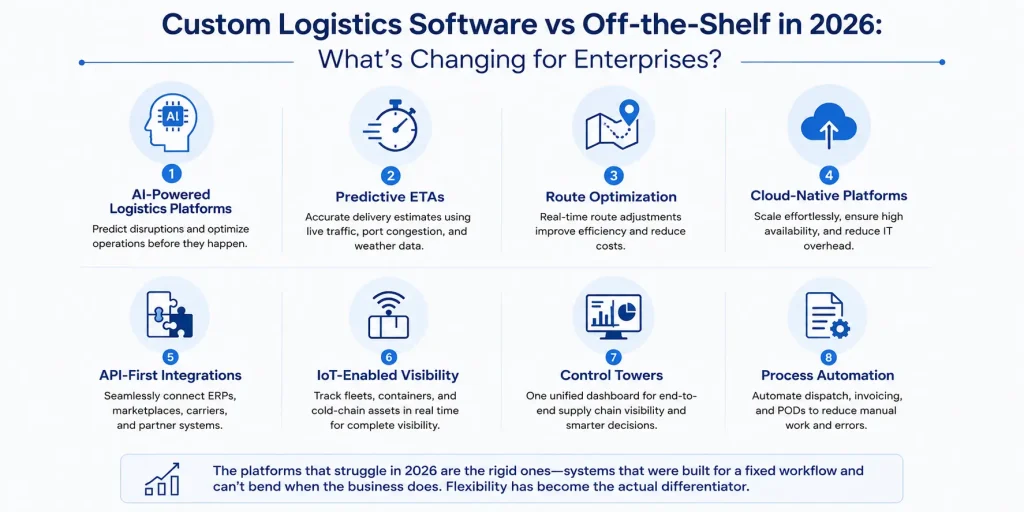
Custom Logistics Software vs Off-the-Shelf in 2026: What’s Changing for Enterprises?
Why logistics software decisions are becoming business strategy decisions
Five years ago, choosing a TMS or WMS was mostly an IT procurement task. Today it’s closer to a board-level decision. The software you pick determines how fast you can onboard a new trade lane, how much visibility you can give a key account, and whether your AI initiatives have clean data to work with in the first place. Get it wrong, and you’re not just dealing with a clunky tool — you’re capping how fast the whole business can grow.
Technology trends influencing enterprise logistics
A handful of shifts are pushing this decision higher up the priority list:
- AI-powered logistics platforms that predict disruptions before they happen
- Predictive ETAs built on live traffic, port congestion, and weather data
- Route optimization engines that adjust in real time, not just at planning stage
- Cloud-native platforms that scale without a hardware refresh
- API-first integrations that connect ERPs, marketplaces, and carrier systems
- IoT-enabled visibility across fleets, containers, and cold-chain assets
- Control towers that give one screen for the entire supply chain
- Automation replacing manual data entry across dispatch, invoicing, and PODs
None of this is optional anymore. The platforms that struggle in 2026 are the rigid ones — systems that were built for a fixed workflow and can’t bend when the business does. Flexibility has become the actual differentiator, more than any single feature on a spec sheet.
Why One-Size-Fits-All Logistics Platforms Don’t Always Work for Dubai Enterprises
GCC cross-border logistics complexity
Moving freight across the GCC means dealing with different customs regimes, documentation standards, and duty structures depending on the country pair. A platform built for a single-market operation in Europe or the US simply doesn’t have the logic to handle six different border processes running in parallel.
Free-zone compliance requirements
UAE free zones like JAFZA, Dubai South, and DAFZA each carry their own compliance rules, reporting formats, and customs procedures. Off-the-shelf platforms rarely build these in natively — they’re too specific to one region to justify the development cost for a global vendor. Enterprises end up bolting on spreadsheets and manual workarounds just to stay compliant.
Port-driven logistics around Jebel Ali
Jebel Ali is one of the busiest transshipment hubs in the world, and port-side operations there move fast. Berth scheduling, container tracking, and last-mile handoffs all need to sync in near real time. A generic TMS built for inland trucking in another market often can’t model that kind of port-centric flow without heavy customization.
Cold-chain logistics and extreme climate
Pharma, food, and perishables moving through Dubai’s heat need continuous temperature monitoring, not periodic checks. Standard WMS modules built for temperate climates tend to treat cold-chain as an add-on rather than a core requirement — which is exactly backwards for a market where a two-hour tarmac delay in July can spoil a shipment.
Arabic-English operational requirements
Bilingual documentation, dual-language customer communication, and Arabic-compliant invoicing aren’t nice-to-haves here — they’re operational necessities. Many international platforms support Arabic as a UI language but not as a full operational layer across documents, notifications, and reporting.
Put these together and you can see why regional complexity exposes the ceiling of generic platforms fairly quickly. It’s not that off-the-shelf software is poorly built — it’s built for an average use case, and Dubai’s logistics environment is rarely average. This is exactly the gap that specialized Logistics Software Development Services in Dubai exist to close, because they’re built around these regional realities from day one rather than retrofitted onto them.
Understanding Off-the-Shelf Logistics Software
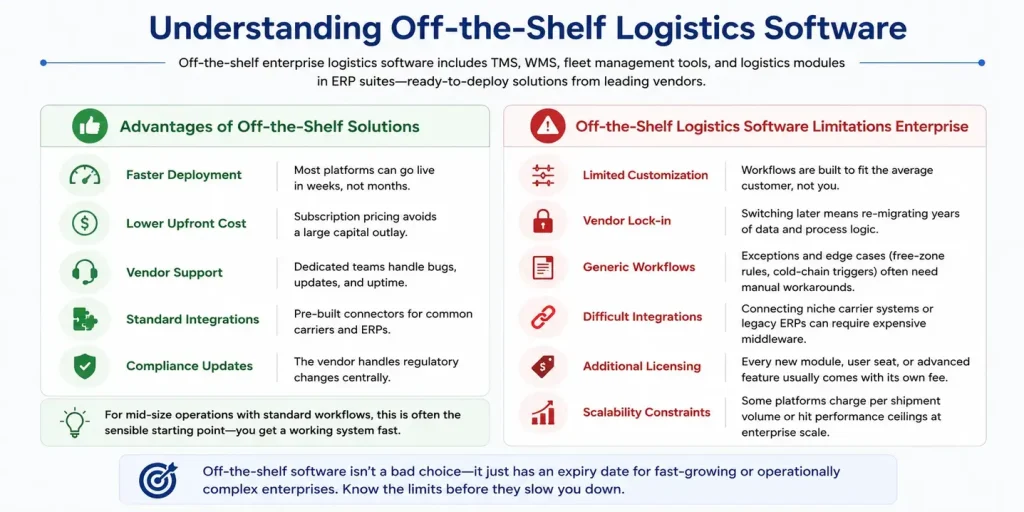
Off-the-shelf enterprise logistics software covers a broad category: transportation management systems (TMS), warehouse management systems (WMS), fleet management tools, and logistics modules bundled inside larger ERP suites. Vendors like SAP, Oracle, Manhattan Associates, and a long list of smaller SaaS players sell these as ready-to-deploy products.
Advantages of off-the-shelf solutions
- Faster deployment — most platforms can go live in weeks, not months
- Lower upfront cost — subscription pricing avoids a large capital outlay
- Vendor support — dedicated teams handle bugs, updates, and uptime
- Standard integrations — pre-built connectors for common carriers and ERPs
- Compliance updates — the vendor handles regulatory changes centrally
For a mid-size operation with fairly standard workflows, this is often the sensible starting point. You get a working system fast, and you’re not the one debugging it at 2 a.m.
Off-the-shelf logistics software limitations enterprise
The cracks tend to show once a business scales past a certain point. Common off-the-shelf logistics software limitations enterprise teams run into include:
- Limited customization — workflows are built to fit the average customer, not you
- Vendor lock-in — switching later means re-migrating years of data and process logic
- Generic workflows — exceptions and edge cases (free-zone rules, cold-chain triggers) often need manual workarounds
- Difficult integrations — connecting niche carrier systems or legacy ERPs can require expensive middleware
- Additional licensing — every new module, user seat, or advanced feature usually comes with its own fee
- Scalability constraints — some platforms charge per shipment volume or hit performance ceilings at enterprise scale
None of this makes off-the-shelf software a bad choice. It just means the fit has an expiry date for fast-growing or operationally complex enterprises — and it’s worth knowing that going in.
Understanding Custom Logistics Software
What makes custom logistics software different?
Custom logistics software is built specifically around your business — your routes, your customer tiers, your compliance obligations, your existing tech stack. Instead of adapting your operations to fit the tool, the tool is built to fit the operations you already run.
Benefits for enterprise operations
- Tailored workflows that mirror how your dispatch, warehouse, and finance teams actually work
- Better integration with legacy ERPs, regional customs portals, and niche carrier APIs
- Competitive differentiation — a customer portal or pricing engine your competitors can’t just buy off a shelf
- Better analytics built around the metrics that matter to your business, not a generic dashboard
- Automation designed around your specific exception cases, not a one-size rule engine
- Scalability that grows with shipment volume without hitting artificial licensing caps
- Ownership of data — full control over where it’s stored, how it’s structured, and who can access it
- AI readiness — clean, custom data architecture is what actually makes AI use cases in logistics viable, since most off-the-shelf systems weren’t designed with machine learning pipelines in mind
The trade-off is upfront investment and a longer build timeline. Which raises the real question: when does that trade-off actually pay off? We’ll get to a practical answer for that shortly.
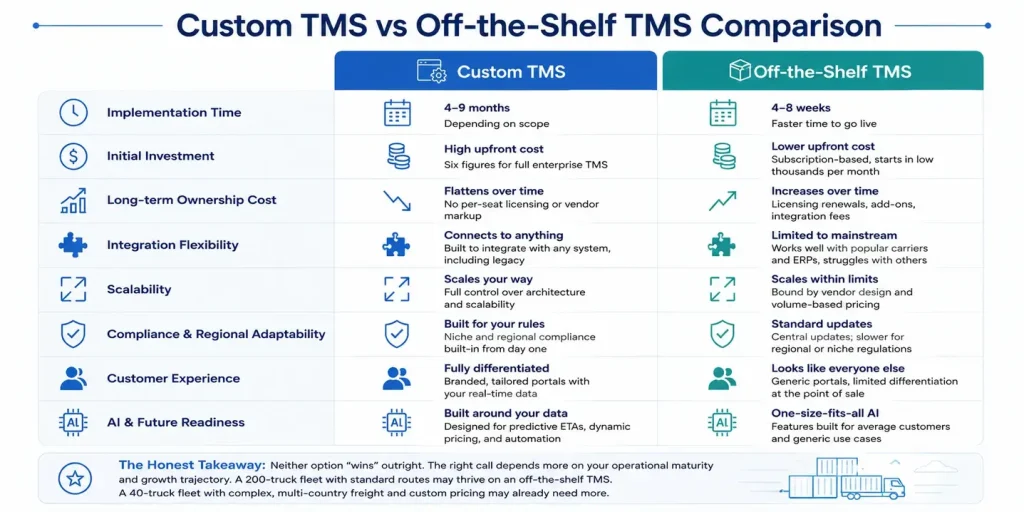
Custom TMS vs Off-the-Shelf TMS Comparison
Implementation time
Off-the-shelf TMS platforms typically go live in 4-8 weeks. A custom TMS build usually takes 4-9 months, depending on scope. If you need something running before peak season, that gap matters.
Initial investment
Off-the-shelf pricing is subscription-based, often starting in the low thousands of dollars per month depending on user count and modules. Custom builds carry a much larger upfront cost — six figures isn’t unusual for a full enterprise TMS — but there’s no recurring per-seat licensing eating into margins later.
Long-term ownership cost
This is where the math flips. Off-the-shelf platforms accumulate cost over time through licensing renewals, per-module add-ons, and integration fees. A custom system’s cost of logistics software is front-loaded but tends to flatten out, since you’re not paying a vendor markup on every new feature or user.
Integration flexibility
Off-the-shelf platforms connect well with mainstream carriers and popular ERPs but often struggle with regional or legacy systems. Custom software can be built to talk to literally anything — including that one 15-year-old customs system nobody wants to touch but everyone still depends on.
Scalability
Off-the-shelf platforms scale within the boundaries the vendor designed for — and sometimes charge more as you grow past certain thresholds. Custom systems scale according to your architecture decisions, which means more control but also more responsibility for planning ahead.
Compliance and regional adaptability
Off-the-shelf vendors update compliance centrally, which is convenient for standard regulations but slow for niche, regional ones like UAE free-zone documentation. Custom software can bake these rules in natively from day one.
Customer experience
A generic tracking portal looks the same as every competitor’s. A custom-built customer experience — branded, tailored to your service tiers, integrated with your actual data — is one of the few logistics touchpoints that genuinely differentiates you at the point of sale.
AI and future readiness
Off-the-shelf platforms are starting to bolt on AI features, but they’re built for the average customer’s data, not yours. Custom systems can be architected around your specific data from the start, which matters a lot once you start exploring predictive ETAs, dynamic pricing, or automated exception handling.
The honest takeaway: neither option “wins” outright. The right call depends more on your operational maturity and growth trajectory than on your company’s size alone. A 200-truck fleet running standard routes might do perfectly well on an off-the-shelf TMS. A 40-truck fleet running complex multi-country freight with custom pricing models might already be outgrowing one.
Build vs Buy Logistics Software for Enterprises: How to Make the Right Decision
This is the practical framework for build vs buy logistics software for enterprises — the question every operations and IT leader eventually has to answer.
Buy when…
- Your operations follow fairly standard, repeatable processes
- You’re running a smaller logistics network without heavy regional complexity
- You need something live in weeks, not months
- Your IT team is lean and can’t support a long custom build
Build when…
Here’s when to build custom logistics software makes sense:
- You operate across multiple countries with different compliance rules
- You need custom pricing models that generic platforms can’t support
- You’re investing in advanced automation or AI-driven decision-making
- Your shipment volume is high enough that per-transaction licensing fees add up fast
- Your workflows are part of your competitive edge, not just operational plumbing
Consider a hybrid strategy
For most growing enterprises, the smartest move isn’t a binary choice — it’s a hybrid one. Buy the core TMS or WMS for the operational backbone you don’t need to reinvent. Then build the pieces that actually differentiate you:
- Customer-facing portals and tracking experiences
- Custom analytics and reporting layers
- AI-driven forecasting and exception handling
- Workflow automation for region-specific processes
- Integrations that connect the core platform to everything else you run
This approach keeps deployment fast where speed matters and gives you ownership where differentiation matters. It’s increasingly the default recommendation for enterprise logistics software strategy in 2026, rather than an all-or-nothing bet on either side.
Future-Proofing Enterprise Logistics Beyond 2026
AI-native logistics platforms
The next wave isn’t AI bolted onto existing software — it’s platforms designed around AI from the ground up, where prediction and automation are core functions, not add-on modules.
Predictive supply chain visibility
Instead of reacting to a delayed shipment, predictive systems flag the risk days in advance, based on port congestion patterns, weather forecasts, and historical carrier performance.
IoT-enabled fleet intelligence
Sensors across trucks, containers, and warehouses are generating more usable data every year — fuel efficiency, driver behavior, cargo condition — feeding directly into decision-making rather than sitting in a report nobody reads.
Cloud-native logistics ecosystems
Systems built cloud-native from the start scale more easily and integrate more cleanly with the AI and IoT layers above. Legacy on-premise systems, whether custom or off-the-shelf, are the ones struggling to keep pace.
The common thread: enterprises should be evaluating software investments on adaptability, not just on whether it solves today’s problem. A platform that fits perfectly now but can’t absorb tomorrow’s requirements is a short-term fix wearing a long-term price tag.
Build Logistics Software That Grows With Your Business
Whether you’re modernizing an existing transportation platform, integrating warehouse operations, or planning a cloud-native logistics ecosystem, choosing the right technology approach can significantly impact operational efficiency and long-term growth. Partner with experienced logistics software specialists to evaluate whether a custom solution, an off-the-shelf platform, or a hybrid strategy is the right fit for your enterprise.
Conclusion
There’s no universally better option between custom and off-the-shelf logistics software — anyone who tells you otherwise is selling something. The right call depends on how complex your operations actually are, not on company size or industry averages.
What matters more than upfront cost is long-term scalability. A cheaper platform today that boxes you in within eighteen months isn’t actually cheaper — it’s a delayed expense with interest. For many growing UAE logistics businesses navigating free-zone compliance, cross-border trade, and rising customer expectations, a hybrid strategy tends to deliver the best balance of speed, flexibility, and room to grow.
Before your next contract renewal or platform decision, it’s worth asking a blunt question: is your current system supporting your growth, or quietly limiting it? Between rigid workflows, integration gaps, and licensing ceilings, off-the-shelf platforms can hold enterprises back in ways that only become obvious once you’ve outgrown them — often right when a system that genuinely improves supply chain efficiency would matter most.
Frequently Asked Questions
Is custom logistics software always more expensive than off-the-shelf?
Not over the long run. Off-the-shelf platforms cost less upfront but accumulate licensing, per-seat, and module fees over time. Custom software carries a higher initial build cost but tends to level off, since there’s no recurring vendor markup on new features or users.
How long does it take to build a custom TMS?
Most enterprise-grade custom TMS builds take four to nine months from discovery to go-live, depending on how many modules — dispatch, billing, customer portals, analytics — are in scope. A phased rollout, launching core dispatch and tracking first, can get value in front of users faster.
Can off-the-shelf software handle UAE free-zone compliance?
Some can, with configuration or third-party add-ons, but few handle it natively. JAFZA, Dubai South, and DAFZA each carry distinct documentation and reporting requirements that most global vendors treat as a regional edge case rather than a core feature.
What’s the biggest risk of choosing the wrong option?
Outgrowing the platform mid-scale. Enterprises that pick off-the-shelf software without checking its ceiling often find themselves migrating to a new system at the worst possible time — right in the middle of a growth phase, when downtime is most expensive.
Does a hybrid approach cost more than picking one path?
Usually not, and often less. Buying the core TMS/WMS keeps the operational backbone affordable and quick to deploy, while custom-building only the differentiating pieces — portals, analytics, automation — avoids paying for a full custom rebuild you don’t actually need.