


Key Takeaways
- Dubai’s position as a global trade hub means supply chain efficiency is now a competitive necessity, not just an operational upgrade.
- Most delays trace back to five root causes: disconnected systems, manual documentation, limited visibility, slow decision-making, and inventory inaccuracies.
- Custom logistics software connects ERP, WMS, fleet, customs, CRM, and customer portals into one real-time data layer.
- Off-the-shelf platforms cover generic use cases; custom builds are designed around your specific free zone rules, fleet structure, and warehouse workflow.
- AI-driven forecasting, predictive ETAs, and automated customs workflows are becoming standard features in modern logistics platforms, not add-ons.
- The biggest gains show up in measurable KPIs — order accuracy, inventory accuracy, delivery time, fleet utilization, and cost per shipment.
- Retail, eCommerce, manufacturing, healthcare, food distribution, freight forwarding, 3PL, and cold chain businesses see the highest returns from custom builds.
- Choosing the right development partner matters as much as the software itself — look for logistics-specific expertise, integration capability, cloud architecture, security, and post-launch support.
Dubai moves more cargo through its ports, free zones, and airports than almost anywhere else on earth. Jebel Ali handles over 14 million containers a year. Al Maktoum International is being expanded specifically to handle the region’s growing air freight volumes. And DP World, headquartered right here, runs terminals in over 40 countries. This isn’t a city that dabbles in logistics — it’s built around it.
But being at the center of global trade creates a problem most businesses don’t see coming: the operations that made you competitive five years ago are now the thing slowing you down. A retailer running three separate systems for inventory, dispatch, and customer orders isn’t inefficient by choice — they’re inefficient because those systems were never built to talk to each other. And in a market where same-day delivery is now the baseline expectation, that gap shows up fast, in missed SLAs, angry customers, and margins that quietly erode.
Supply chain efficiency in Dubai has stopped being an operational nice-to-have. It’s the difference between winning a retail contract and losing it to a competitor who can promise (and keep) a tighter delivery window. Generic, off-the-shelf software wasn’t designed for the specific mix of free zone regulations, multimodal transport, and cross-border documentation that defines logistics here — which is exactly why more UAE logistics providers, 3PLs, and distributors are turning to custom logistics software Dubai companies actually need: platforms built around their warehouses, their fleets, and their customs workflows, not a generic template.
This article breaks down what’s actually causing the slowdown in modern supply chains, how custom-built systems fix it, and what to look for if you’re evaluating a development partner.
Why Supply Chain Efficiency Matters More Than Ever for Dubai Businesses
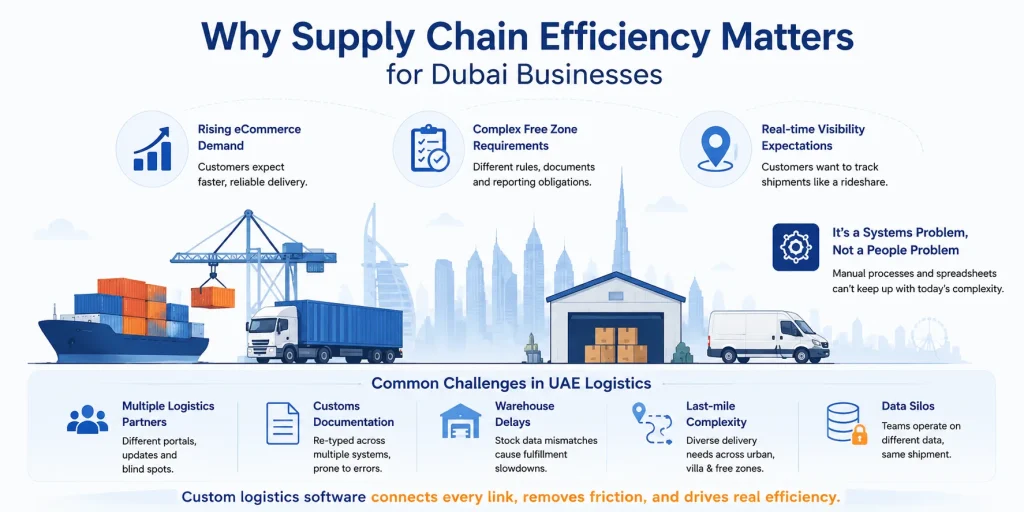
Dubai isn’t just a stopover for global trade — it’s a hub where nearly everything converges. Ships come in through Jebel Ali, goods get re-exported through free zones like JAFZA and DAFZA, and from there they move on to markets across the Middle East, Africa, and South Asia. That volume alone puts pressure on every link in the chain. But three other forces are compounding it.
First, eCommerce demand keeps climbing. Dubai shoppers now expect delivery windows that were unthinkable a few years ago, and retailers who can’t meet them lose the sale to someone who can. Second, free zones add a layer of complexity that most off-the-shelf software simply wasn’t built for — different customs rules, different documentation requirements, different reporting obligations depending on which zone a shipment moves through. Third, customer expectations around visibility have shifted. People don’t just want their order to arrive on time; they want to track it, in real time, the way they track a rideshare.
Here’s the catch: none of this is solvable with more people or more spreadsheets. It’s a systems problem.
Most mid-sized and growing logistics operations in the UAE are still coordinating manually across:
- Multiple logistics partners — each with its own portal, its own update cadence, its own blind spots
- Customs documentation — often re-typed by hand across two or three different systems
- Warehouse delays — caused by stock data that’s accurate on paper but wrong on the shelf
- Last-mile complexity — dense urban routes, villa communities, and free zone drop-offs that don’t fit a single delivery model
- Data silos — where the warehouse team, the fleet team, and the finance team are all looking at different numbers for the same shipment
Individually, each of these is a minor friction point. Together, they add hours to every order cycle and dollars to every shipment. That’s the gap custom logistics software is built to close. If you’re looking for custom logistics software explained in detail—including how it works, its core features, implementation process, and the business value it delivers—our complete guide walks you through everything you need to know before choosing the right solution for your logistics operations.
What’s Slowing Down Modern Supply Chains?
Before fixing anything, it helps to name exactly where the friction lives. In most logistics operations we look at, the bottlenecks fall into five categories.
Disconnected Systems
ERP handles finance. WMS handles the warehouse. TMS handles transportation. On paper, that’s a clean division of labor. In practice, these systems rarely share data automatically, which means someone — usually a human, usually under time pressure — has to bridge the gap manually. Every manual bridge is a place where errors creep in.
Manual Documentation
Customs forms, delivery notes, invoices — in a lot of Dubai logistics operations, the same shipment details get typed into three or four different places. Repeated data entry isn’t just slow; it’s where typos turn into shipment delays and mismatched invoices.
Limited Visibility
Ask most operations managers where a specific shipment is right now, and you’ll get an estimate, not an answer. Without real-time tracking, “where is it” becomes a phone call to the driver instead of a glance at a dashboard.
Slow Decision Making
When data lags reality by hours, so do decisions. Operations teams end up reacting to problems — a delayed truck, a stockout, a missed pickup window — instead of catching them early enough to route around them.
Inventory Inaccuracies
This is the one that costs the most and gets talked about the least. A mismatch between what the system says is in the warehouse and what’s actually on the shelf leads to overselling, failed fulfillment, and customers who don’t come back. A properly built warehouse management system Dubai businesses can trust in real time is often the single highest-leverage fix in the whole stack — because inventory accuracy is upstream of almost everything else: fulfillment speed, order accuracy, even fleet planning.
Fixing any one of these in isolation helps a little. Fixing all five — by connecting the systems that produce them — is what actually moves the needle on supply chain efficiency Dubai businesses are competing on today.
How Custom Logistics Software Improves Supply Chain Efficiency
This is where the shift from disconnected tools to a purpose-built platform pays off. Here’s what changes, system by system.
Creates One Connected Logistics Ecosystem
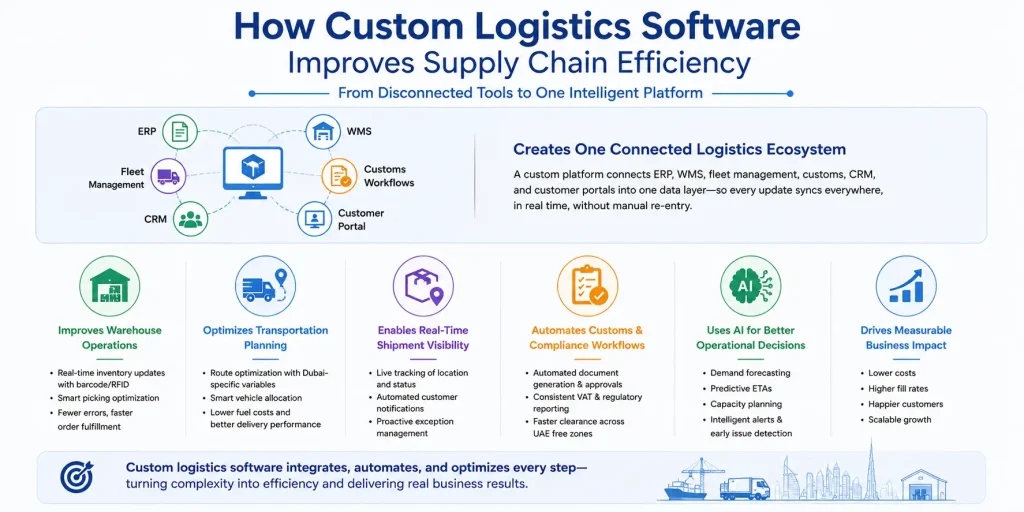
The core value of custom software isn’t any single feature — it’s integration. A well-architected platform connects ERP, WMS, fleet management, customs workflows, CRM, and the customer-facing portal into one data layer. When a shipment status changes in the warehouse, it updates the customer portal, the finance record, and the fleet dispatch view at the same time, without anyone re-entering a thing.
This is also the point where the debate over custom logistics software vs off-the-shelf platforms usually gets settled. Off-the-shelf tools are built for the average use case across thousands of companies — which means they handle maybe 70% of what a Dubai-based operation actually needs, and force workarounds for the rest. Custom software is built around your specific workflow, your specific free zone requirements, and your specific fleet structure from day one.
Improves Warehouse Operations
Warehouse inefficiency rarely shows up as one big failure — it shows up as a hundred small ones. Custom systems tackle this through inventory automation that updates stock counts the moment an item is scanned, barcode and RFID scanning that removes manual counting entirely, and picking optimization that routes warehouse staff along the shortest path instead of a random walk through the aisles. Together, these are the features that turn a warehouse management system Dubai operators use from a passive record-keeping tool into an active operational engine.
Optimizes Transportation Planning
On the transport side, custom platforms bring in route optimization that accounts for Dubai-specific variables — peak traffic corridors, free zone access points, delivery windows tied to building management rules — rather than generic mapping logic. Vehicle allocation gets matched to shipment size and priority automatically. Fuel costs drop because routes are tighter and idle time is lower. And delivery scheduling adjusts dynamically instead of running off a static plan built the night before.
Fleet-heavy operations often ask about the numbers before committing to a build, and that’s a fair question — a detailed breakdown of Fleet Management App Development Cost typically depends on how many vehicles you’re tracking, what level of telematics integration you need, and whether you’re building driver-facing apps alongside the dispatch system.
Enables Real-Time Shipment Visibility
Live tracking isn’t a customer-facing perk anymore — it’s an operational necessity. When a shipment’s location, status, and expected arrival are visible in real time, customer notifications become automatic instead of manual, and exception handling becomes proactive. If a delivery is running late, the system flags it before the customer has to ask, giving dispatch time to reroute or communicate ahead of the problem instead of after it.
Automates Customs & Compliance Workflows
For any business moving goods across UAE free zones or international borders, customs documentation is one of the most error-prone parts of the process. Custom software automates document generation, routes approvals to the right person automatically, and keeps VAT and regulatory reporting consistent across every shipment. This alone can cut days off customs clearance timelines for businesses moving high volumes through JAFZA, DAFZA, or Jebel Ali.
Uses AI for Better Operational Decisions
The most forward-looking custom platforms now build in AI-driven decision support: demand forecasting that flags stock shortages before they happen, predictive ETAs that account for traffic and weather patterns instead of straight-line distance, capacity planning that models fleet and warehouse load ahead of peak seasons, and intelligent alerts that surface problems before they become customer complaints.
Put together, these capabilities are what separate smart logistics solutions Dubai businesses are investing in today from the static, form-based software most companies were still running five years ago. And building all of this well requires genuine domain expertise — which is exactly why the key features of logistics software worth paying for aren’t generic checkboxes, but the specific integration, automation, and AI layers described above. Any credible logistics software development UAE partner should be able to walk you through exactly how each of these pieces fits together for your operation, not just hand you a features brochure.
Real Business Benefits Beyond Faster Deliveries
Faster deliveries get the headlines, but they’re really just the visible symptom of a much larger set of gains. The real payoff of custom logistics software shows up across the whole business.
Better customer satisfaction comes from accurate delivery promises and proactive communication — customers forgive a delay they were warned about far more readily than one they discover on their own. Lower operating costs follow from tighter routes, less fuel waste, and fewer manual corrections. Higher warehouse productivity comes from staff spending less time hunting for stock and more time fulfilling orders. Improved resource utilization means fleets and warehouse space are actually sized to real demand instead of guesswork. Better decision making happens because managers are looking at what’s happening right now, not a report from three days ago. And stronger business scalability means the systems that work at 500 orders a day don’t collapse at 5,000.
None of this is theoretical — it shows up in the numbers operations teams track every week:
| KPI | What Improves |
|---|---|
| Order Accuracy | Fewer mis-picks and mis-shipped orders |
| Inventory Accuracy | System counts match warehouse reality |
| Delivery Time | Tighter, optimized routes and dynamic scheduling |
| Fleet Utilization | Vehicles matched to actual shipment volume |
| Cost Per Shipment | Less fuel waste, less manual rework, fewer errors |
A business tracking these five KPIs consistently already has a clear before-and-after story once a custom system goes live — usually a stronger argument for the investment than any vendor pitch.
Industries in Dubai That Benefit Most from Custom Logistics Software
Not every business needs the same depth of custom build, but a handful of sectors in the UAE see outsized returns from it.
Retail and eCommerce businesses live and die by delivery speed and order accuracy — the two things custom systems fix first. Manufacturing operations depend on raw material and finished goods flow staying tightly synced with production schedules. Healthcare logistics has zero tolerance for delay or mishandling, especially where temperature-sensitive supplies are involved. Food distribution businesses face the same pressure, plus shelf-life constraints that make real-time inventory visibility non-negotiable.
Freight forwarders and 3PL providers are essentially running logistics-as-a-service for their own clients, which means their software has to handle multiple customers, multiple SLAs, and multiple reporting formats at once — something generic tools struggle with. And cold chain logistics providers need temperature monitoring, compliance documentation, and real-time alerts built directly into the platform, not bolted on as an afterthought.
Across all of these, the common thread is the same: businesses with complex, multi-party, time-sensitive operations get the most value from smart logistics solutions Dubai vendors can build around their specific compliance and operational requirements — because generic software simply wasn’t designed for how these industries actually work.
Choosing the Right Logistics Software Development Partner in UAE
Once a business decides custom software is the right path, the harder question is who builds it. A few things separate a partner worth hiring from one that’ll leave you with an expensive, half-finished platform.
Industry expertise matters more than general software experience — a team that’s worked on logistics platforms before will already understand customs workflows, warehouse operations, and fleet management without a long ramp-up. Integration capabilities are non-negotiable, since the whole point of custom software is connecting your existing ERP, WMS, and fleet systems rather than replacing them wholesale. Cloud architecture determines whether the platform can actually scale as order volume grows, and security determines whether sensitive shipment, customer, and financial data stays protected — especially important given UAE data protection requirements. Scalability and post-launch support round out the list: a platform that works well at launch but has no support plan for bug fixes, updates, or scaling issues will cost more in the long run than it saved upfront.
Cost is naturally part of this conversation too. Every serious logistics software development cost estimate should break down by module — warehouse management, fleet tracking, customs automation, AI forecasting — so you can see exactly what you’re paying for and phase the build if needed, rather than committing to everything at once.
If you’re at the evaluation stage, it’s worth treating this like any other major vendor decision: ask for past logistics projects, ask how they’ve handled UAE-specific compliance work before, and ask what post-launch support actually looks like in practice. A capable Supply Chain Software Development Company in Dubai should be able to answer all three without hesitation — and should be walking you through trade-offs, not just selling you a package.
Conclusion
Efficiency has quietly become the biggest competitive advantage in Dubai’s logistics sector — not pricing, not fleet size, but how well a business’s systems talk to each other. Generic software papers over that gap for a while, but it doesn’t close it. The disconnected ERP, the manual customs paperwork, the warehouse counts that don’t match reality — these are systems problems, and they need a systems solution.
Custom logistics software connects every stage of the chain: warehouse, fleet, customs, and customer, all running off the same real-time data. Businesses that invest in this now aren’t just fixing today’s bottlenecks — they’re building the infrastructure to handle next year’s order volume without needing to rebuild from scratch. In a market moving as fast as Dubai’s, that head start is worth more than it looks on a budget spreadsheet.
If your team is still coordinating shipments across spreadsheets and phone calls, the gap between you and a competitor running a connected system is only going to widen from here.
Frequently Asked Questions
Why do Dubai logistics companies prefer custom logistics software over off-the-shelf solutions?
Custom logistics software is tailored to a company’s workflows, warehouse operations, transportation processes, and compliance requirements. Unlike generic platforms, it integrates seamlessly with existing systems, helping Dubai businesses improve efficiency, scalability, and visibility across the entire supply chain.
How does custom logistics software improve supply chain efficiency?
Custom logistics software improves supply chain efficiency Dubai by automating repetitive tasks, reducing manual errors, enabling real-time shipment tracking, optimizing inventory, and connecting warehouses, transportation, and customer operations through a single, centralized platform.
Can custom logistics software integrate with existing business systems?
Yes. Modern logistics software development UAE focuses on seamless integration with ERP, CRM, Warehouse Management Systems (WMS), Transportation Management Systems (TMS), accounting software, GPS tracking, and IoT devices to eliminate data silos and streamline operations.
What features should businesses look for in smart logistics software?
Businesses should prioritize smart logistics solutions Dubai with real-time tracking, warehouse management, inventory control, route optimization, fleet monitoring, analytics dashboards, automated workflows, customer portals, and API integrations that support future business growth.
Is a warehouse management system enough to manage logistics operations?
No. A warehouse management system Dubai optimizes inventory and warehouse activities, but complete logistics operations also require transportation management, fleet tracking, order processing, customer communication, and reporting for end-to-end supply chain visibility.
Which businesses benefit most from custom logistics software in Dubai?
Freight forwarders, 3PL providers, manufacturers, distributors, retailers, eCommerce businesses, and cold-chain operators benefit the most. Companies handling high shipment volumes or complex supply chains gain greater operational efficiency, visibility, and long-term scalability through customized logistics solutions.