


Key Takeaways
- Pricing spans three tiers in 2026: MVP (AED 40k–80k), mid-level (AED 80k–200k), and enterprise (AED 200k–900k+), each with its own timeline of 3 to 12 months.
- Cost follows business goals, not just features — two platforms with identical feature lists can price differently based on compliance needs, integrations, and scalability plans.
- 12 factors drive the final number, from software type and feature complexity to team location, QA depth, and post-launch maintenance.
- UAE compliance isn’t optional overhead — PDPL, Dubai Trade, RTA, and VAT logic are baseline engineering work, not add-ons.
- Hidden costs add up fast: API fees, hosting renewals, staff training, compliance audits, and true Arabic localization rarely show up in the initial build quote.
- Maintenance typically runs 15–20% of build cost annually — budget for the relationship, not just the launch.
- MVP-first is the smartest way to control cost without compromising quality — validate the core workflow before investing in the full feature set.
- Custom software pays for itself operationally — faster deliveries, fewer bottlenecks, and better scalability outweigh the sticker price over time.
- A tailored estimate beats any generic benchmark — the only number worth budgeting around is one scoped to your actual operations and compliance needs.
The UAE’s logistics sector isn’t just growing — it’s rebuilding itself around software. Freight forwarders that once ran on spreadsheets are now tracking shipments in real time. Distributors that used to call drivers for updates are watching route data on a dashboard. And almost every logistics operator in Dubai, Sharjah, and Abu Dhabi is asking some version of the same question: what does logistics software actually cost in 2026?
There’s no single number that answers that honestly. The logistics software development cost in UAE can range from AED 40,000 for a lean MVP to well over AED 900,000 for a full enterprise platform — and the gap between those two figures comes down to real, specific choices, not vague “it depends” hand-waving. A fleet tracking app for 15 vehicles costs nothing like a multi-warehouse platform integrating with Dubai Trade and three ERPs.
This guide breaks down exactly where that money goes. You’ll get realistic 2026 pricing ranges, a full walkthrough of the 12 factors that move the number up or down, the hidden costs most businesses forget to budget for, and practical ways to control spend without shipping something flimsy.
Why the Logistics Software Development Cost in UAE Varies So Much
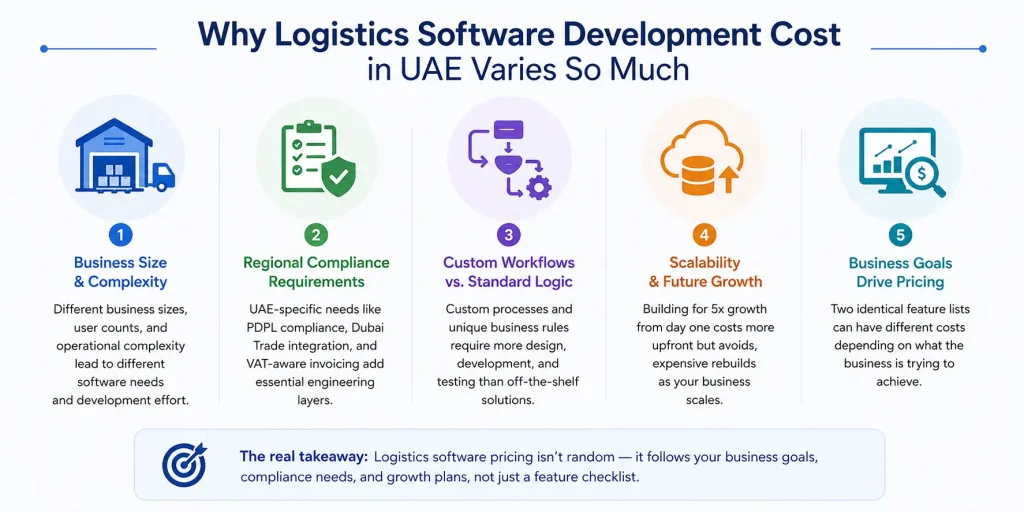
Ask five logistics companies in the UAE what they paid for their software, and you’ll get five wildly different answers — and all five could be correct. The variance isn’t random. It comes from a handful of structural differences between projects.
Business size is the obvious one. A three-warehouse distributor building an internal WMS has different needs than a last-mile courier serving all seven emirates. But size alone doesn’t explain it. Two companies of identical size can land on completely different budgets based on how many users touch the system, how complex their day-to-day operations are, and whether they need custom workflows or can live with off-the-shelf logic.
Regional compliance adds another layer that many first-time buyers underestimate. UAE-specific requirements — PDPL data handling, Dubai Trade integration, VAT-aware invoicing — aren’t optional add-ons. They’re baseline engineering work that a generic logistics platform built for, say, the UK market simply won’t have.
Then there’s scalability. A platform built to handle today’s shipment volume is cheaper than one architected to handle 5x that volume without a rebuild. The smart move is planning for growth from day one — which is exactly where a solid logistics software development roadmap earns its keep, because it forces those growth decisions upfront instead of as expensive afterthoughts.
The real takeaway: pricing follows business goals, not a feature checklist. Two identical feature lists can cost differently depending on what the business is actually trying to achieve.
How Much Does Logistics Software Cost in Dubai in 2026?
Here’s the direct answer, because you shouldn’t have to read 2,000 words to find it.
| Software Type | Estimated Cost (AED) | Timeline |
|---|---|---|
| MVP | 40,000 – 80,000 | 3–4 Months |
| Mid-Level | 80,000 – 200,000 | 5–7 Months |
| Enterprise | 200,000 – 900,000+ | 8–12 Months |
If you’re wondering how much does logistics software cost in Dubai for your specific stage of business, these three tiers map roughly to three types of companies.
Startup projects sit in the MVP range. Think a single-city delivery startup validating demand with core tracking and dispatch features — nothing fancy, just enough to prove the model works before raising the next round or reinvesting revenue.
SME projects land in the mid-level tier. A regional distributor or 3PL operator with a handful of warehouses, moderate integration needs (one ERP, one payment gateway), and a small but real user base falls here.
Enterprise projects are the AED 200k–900k+ builds — multi-warehouse networks, freight marketplaces, or fleet operators running hundreds of vehicles across multiple emirates, with deep integrations, custom compliance workflows, and AI-driven optimization baked in from day one.
One thing worth saying plainly: the timeline isn’t just a courtesy figure. Longer timelines mean more engineering hours, which is most of what you’re paying for in the first place.
12 Factors That Affect Logistics Software Development Cost in UAE
This is the section that actually explains your quote. Every one of the factors affecting logistics software pricing UAE below either adds engineering hours, requires specialized expertise, or increases ongoing operational overhead—and all three directly influence the final project cost. At the same time, these investments determine how effectively your software improves supply chain efficiency, supports business growth, and delivers long-term operational value.
1. Type of Logistics Software You’re Building
Fleet management software, a warehouse management system (WMS), a transportation management system (TMS), a last-mile delivery app, and a freight marketplace are not interchangeable builds. A fleet management tool centers on GPS tracking and vehicle telemetry. A WMS centers on inventory logic and warehouse floor operations. A freight marketplace needs a two-sided platform with bidding, matching, and payment logic. Each category pulls in a different set of specialists, and that shows up directly in the quote.
2. Feature Complexity
Real-time shipment tracking is table stakes now — most buyers assume it’s included. What separates a AED 60k build from a AED 250k build is what sits on top of that: AI-driven route optimization, automated dispatch that reassigns drivers on the fly, warehouse automation tied to IoT sensors, and predictive analytics that flag delays before they happen. Each of these is its own mini-project, not a checkbox.
3. Third-Party Integrations
Almost no UAE logistics platform stands alone. It needs to talk to an existing ERP, connect with Dubai Trade for customs documentation, process payments through a local gateway, pull live maps data, and fire SMS notifications to customers and drivers. Every integration point means testing against someone else’s API, handling their failure modes, and keeping the connection stable as their system updates. Three integrations is a manageable scope. Eight integrations is a different project entirely.
4. UAE Compliance & Security Requirements
This is where generic offshore quotes fall apart. Building for the UAE market means engineering around PDPL data protection requirements, Dubai Trade’s documentation standards, RTA regulations if vehicles are involved, and often ISO 27001-aligned security practices for enterprise clients. VAT-compliant invoicing adds its own logic layer. None of this is glamorous work, but skipping it isn’t an option if you’re operating here — and retrofitting compliance after launch costs more than building it in from the start.
5. Number of Platforms
A web dashboard alone is one build. Add an Android driver app, an iOS driver app, a separate admin portal, and a customer-facing portal, and you’re now maintaining four to five distinct interfaces that all need to stay in sync with the same backend. Cross-platform frameworks can trim this cost, but they don’t eliminate it — each surface still needs its own design pass and testing cycle.
6. Technology Stack & Architecture
A monolithic architecture is cheaper to build initially but harder to scale later. Microservices cost more upfront but let you scale individual components — say, the route optimization engine — independently as volume grows. Cloud-native builds, AI model integration, and IoT device connectivity each add architectural decisions that ripple through the entire cost estimate. This is a case where the cheaper initial choice can become the expensive long-term one.
7. UI/UX Design Requirements
A driver navigating a warehouse floor needs a different interface than an operations manager reviewing dashboards from a desk. Add a genuine bilingual Arabic-English interface — not a bolted-on translation, but a proper right-to-left design pass — and design hours climb. Custom dashboards for different user roles, driver-friendly screens usable with one hand in a moving vehicle, and polished customer portals all add design and front-end development time that’s easy to underestimate at the quoting stage.
8. Development Team Location
UAE-based development teams typically charge the most per hour but offer the tightest timezone alignment and easiest in-person collaboration. Indian development teams often run 40–60% cheaper with strong technical depth, though communication needs more structure. Eastern European teams sit in between on cost, with strong engineering standards and reasonable timezone overlap. Hybrid models — local project management paired with an offshore engineering team — are increasingly common because they balance cost against oversight. Whichever route you take, working with an established Logistics Software Development Company in Dubai that understands local compliance tends to prevent expensive rework later, even if the initial quote looks higher than a pure offshore option.
9. Cloud Infrastructure & Hosting
AWS and Azure both offer UAE-region data centers now, which matters for latency and data residency requirements. Local hosting providers are an option for businesses with strict data-sovereignty needs. Whichever you choose, scalability planning and security configuration (firewalls, encrypted storage, access controls) are recurring costs, not one-time setup fees — budget for them monthly, not just at launch.
10. Testing & Quality Assurance
Skipping QA to save money is the single most common way logistics software projects go wrong after launch. Performance testing under real shipment volumes, security testing against data breaches, device testing across the phone models your drivers actually carry, and user acceptance testing with real operations staff — all of it takes time, and all of it is cheaper to do before launch than after a warehouse team is stuck with a system that crashes during peak hours.
11. Post-Launch Maintenance & Support
Software isn’t a one-time purchase — it’s closer to a subscription in terms of ongoing cost. Bug fixes, feature updates as your operations evolve, uptime monitoring, security patches, and server management typically run 15–20% of the original build cost annually. Vendors who don’t mention this upfront usually aren’t hiding it maliciously — they’re just quoting the build, not the relationship. Ask about it directly.
12. Future Scalability & Customization
The cheapest platform today can become the most expensive platform in three years if it can’t grow with you. Modular architecture, AI-readiness (even if you’re not using AI features yet), multi-warehouse support, and the flexibility to expand into Saudi Arabia or other GCC markets all cost more to build now — but far less than rebuilding from scratch once you’ve outgrown a rigid system. This is exactly the kind of decision an enterprise logistics software dubai guide walks through in more depth, because enterprise buyers are the ones who feel this trade-off most acutely.
Hidden Costs Businesses Often Miss When Estimating Logistics Software Development Cost in UAE
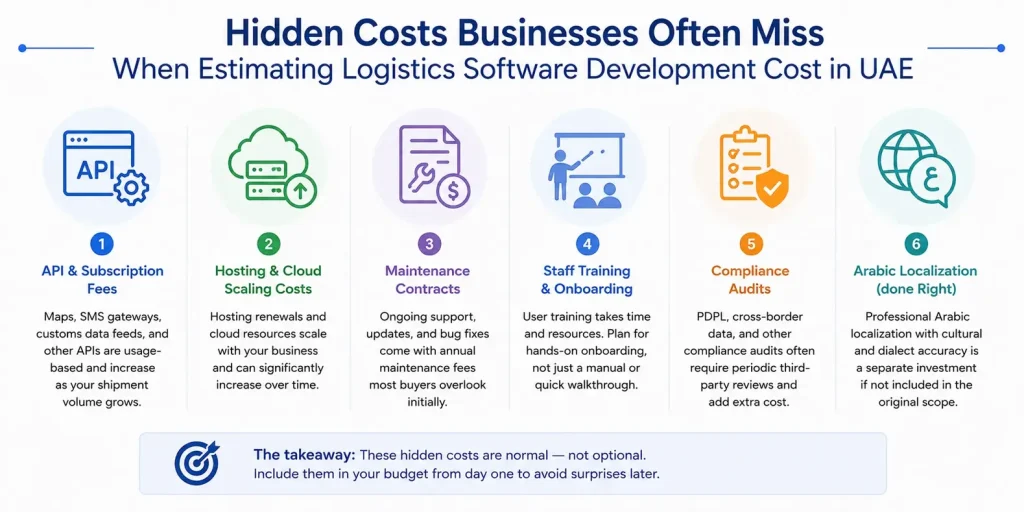
The build quote is rarely the full picture. A handful of recurring costs tend to surprise buyers six months after launch, mostly because vendors don’t always volunteer them upfront.
API subscription fees for maps, SMS gateways, and customs data feeds are usage-based and scale with your shipment volume — a cost that grows as your business succeeds, which is easy to forget when you’re budgeting against current volume. Hosting renewals and cloud scaling costs climb the same way. Maintenance contracts, covered above, are an annual line item most first-time buyers leave out of their initial budget entirely.
Staff training is another one. A beautifully built system that your warehouse team doesn’t know how to use isn’t saving anyone money. Budget real hours for onboarding, not just a PDF manual. Compliance audits — particularly for PDPL and, if you’re handling international freight, cross-border data requirements — often need periodic third-party review, which is a cost separate from the development contract. And genuine Arabic localization, done properly with cultural and dialectal accuracy rather than machine translation, is its own line item if it wasn’t scoped into the original build.
None of these should be dealbreakers. They should be in your spreadsheet from day one.
How to Reduce Logistics Software Development Cost Without Compromising Quality
Cutting corners on logistics software almost always costs more later — a system that fails during peak season is a far more expensive problem than the money saved by skipping QA. But there are legitimate ways to bring the number down.
Build an MVP first. Validate your core workflow with essential features before investing in the full feature set — you’ll often discover that some “must-have” features weren’t actually necessary once real users start using the system. Prioritize ruthlessly around what solves the biggest operational pain today, not what looks impressive in a demo. Choose modular architecture from the start so you can add capabilities later without a rebuild. Use cross-platform development frameworks to cut the cost of maintaining separate iOS and Android codebases. Plan your integrations early — bolting on an ERP connection after the core system is built almost always costs more than scoping it from the start.
Working with an experienced partner matters more than it sounds. A team that’s already built for cost to build custom logistics software UAE requirements — meaning they already understand PDPL, Dubai Trade, and VAT logic — won’t bill you to learn those requirements from scratch on your project. And hybrid development teams, pairing local oversight with offshore engineering capacity, often hit the sweet spot between cost control and quality assurance.
The businesses that overspend usually aren’t the ones with big feature lists. They’re the ones who skipped planning and paid for rework instead. A platform built without this discipline is also one of the more common paths to Supply Chain Management Failure — not because the software was bad, but because it was scoped in a hurry.
Is Custom Logistics Software Worth the Investment for UAE Businesses?
Cost is only half the conversation. The other half is what the software actually returns.
Faster deliveries from optimized routing translate directly into customer retention in a market where same-day and next-day expectations keep rising. Reduced operational costs come from cutting the manual coordination — phone calls, spreadsheets, guesswork — that eats hours out of every dispatcher’s day. Better compliance means fewer costly delays at customs and less exposure to PDPL penalties. Improved customer experience, from real-time tracking to accurate delivery windows, is increasingly what separates logistics providers that win repeat contracts from the ones that don’t.
Scalability is the quieter benefit. The right platform lets a business expand into a new emirate, or a new GCC market, without a technology overhaul standing in the way. And done right, this is exactly how logistics software supports UAE enterprise growth — not as a cost center, but as the operational backbone that lets a company take on more volume without a proportional increase in headcount.
Custom software also tends to be the difference-maker in a crowded market. Off-the-shelf tools work until your operations get specific enough that generic workflows start creating friction. At that point, custom development stops being a luxury and becomes the more economical option — it’s often what separates operators that consistently reduce operational bottlenecks. from the ones still fighting the same recurring delays every quarter.
Viewed this way, logistics software isn’t really an expense line. It’s closer to infrastructure — the kind of investment that pays for itself in operational efficiency long before the ROI conversation even starts feeling urgent.
Final Thoughts
There’s no universal price tag for logistics software in the UAE, and any vendor who quotes you a number before understanding your operations, compliance needs, and growth plans is guessing. The real budget depends on the type of software you’re building, how many integrations it needs, how many platforms it has to run on, and how much scalability you’re planning for from day one.
What’s consistent across every successful project is this: businesses that plan strategically upfront — scoping compliance, integrations, and future growth before writing a line of code — avoid the expensive redesigns that hit companies who tried to save money by skipping that step. A AED 60,000 MVP that gets rebuilt twice within two years usually ends up costing more than a properly scoped AED 150,000 build that didn’t need touching.
If you’re weighing your options, the most useful next step isn’t reading another generic pricing benchmark — it’s getting a cost estimate tailored to your actual operations, your growth plans, and your specific compliance requirements. That’s the only number that’s actually worth budgeting around.
Frequently Asked Questions
How much does logistics software development cost in the UAE?
The logistics software development cost in UAE typically ranges from AED 40,000 for a basic MVP to over AED 900,000 for enterprise platforms, depending on features, integrations, compliance requirements, and overall project complexity.
What factors affect logistics software pricing in the UAE?
Major pricing factors include software type, feature complexity, third-party integrations, cloud infrastructure, UAE compliance, development team location, platform selection, security requirements, scalability, testing, and long-term maintenance.
Is custom logistics software more expensive than off-the-shelf solutions?
Yes, custom logistics software requires a higher upfront investment, but it offers tailored workflows, seamless integrations, better scalability, stronger security, and lower long-term operational costs than generic software.
How long does it take to build logistics software in Dubai?
Development timelines generally range from 3–4 months for a basic solution to 8–12 months or longer for enterprise-grade logistics platforms with advanced automation, AI capabilities, and complex integrations.
How can businesses reduce logistics software development costs without sacrificing quality?
Businesses can control costs by starting with an MVP, prioritizing essential features, choosing modular architecture, using cross-platform development, and partnering with experienced development teams that understand UAE logistics requirements.