


key Takeaways
- Cloud logistics is replacing manual, spreadsheet-based coordination in UAE
- Growth drivers: e-commerce demand, free zone expansion, customs pressure, seasonal peaks
- Scalability lets businesses add locations/fleets without rebuilding infrastructure
- Must-have features: real-time visibility, AI route optimization, cloud TMS, UAE compliance
- Benefits: lower costs, faster decisions, easier expansion
- Challenges: system integration, data security, employee adoption
- Choose vendors with real UAE experience and integrations, not generic templates
- Future trends: AI forecasting, IoT, smart warehouses, EV fleets
Walk into any major distribution hub in Jebel Ali or Dubai South today and you’ll notice something: the loudest tool in the room is no longer a walkie-talkie or a printed manifest. It’s a dashboard. UAE logistics has quietly gone through a full operating-system change, and most of it happened on the cloud.
Dubai, Abu Dhabi, and the UAE’s free zones have spent the last decade positioning themselves as the connective tissue between Asia, Europe, and Africa. That ambition only works if businesses moving goods through this corridor can keep pace with the volume. Spreadsheets, WhatsApp groups for dispatch coordination, and disconnected point solutions used to be good enough. They aren’t anymore.
What’s replaced them is a wave of cloud-based logistics software UAE companies are adopting to run transportation, warehousing, fleet, and delivery operations from a single connected system. This isn’t a minor upgrade. It’s a redesign of how supply chains are built — around real-time data instead of end-of-day phone calls.
More than that, businesses across the country aren’t just buying cloud-based logistics software UAE vendors are selling off the shelf. They’re rebuilding their operations around it, from how dispatch decisions get made to how customers are kept in the loop.
In this guide, we’ll cover why cloud logistics adoption is accelerating across the UAE, the features that actually matter in 2026, the real benefits and the real challenges, and how to choose a platform that fits a UAE-specific operation rather than a generic global template.
What Is Cloud-Based Logistics Software and Why Is It Important in UAE?
Understanding Cloud-Based Logistics Software
So, what is cloud-based logistics software, in plain terms? It’s a hosted platform, accessed over the internet, that ties together transportation, inventory, warehouse management, fleet tracking, delivery execution, and reporting into one system. No servers to maintain on-site. No IT team babysitting hardware in a back room.
The short version: it moves the entire operation off local hardware and onto a platform any authorized team member can access from anywhere, updated in real time.
That distinction matters more than it sounds. A traditional on-premise system locks a company into the capacity it bought on day one. The cloud-based logistics software UAE businesses are switching to instead scales with the operation — a company running three trucks and one running three hundred can use the same underlying platform, just configured differently.
For operators managing warehouses in Jebel Ali, a fulfillment center in Dubai South, and delivery fleets across Sharjah, this also means something practical: one login, one source of truth, no reconciling three different spreadsheets at the end of the week. A well-built cloud logistics platform UAE operators can rely on turns that fragmented picture into one that actually holds together.
Why UAE Businesses Are Moving Toward Cloud Logistics Solutions
E-commerce is the biggest one. Shoppers in Dubai now expect same-day or next-day delivery as a baseline, not a premium option. That expectation puts pressure on every link in the chain, from warehouse pick times to last-mile routing.
The expansion of logistics-focused free zones — DAFZA, JAFZA, and the wider Dubai South ecosystem — has also pulled in a steady stream of regional distribution operations that need real-time shipment visibility across borders, not just within a single warehouse.
Add faster customs clearance demands, tighter compliance requirements, and a crowded field of providers all competing on speed, and manual coordination simply can’t keep up.
The pain points show up in predictable ways:
- Dispatch and warehouse teams coordinating through phone calls and messaging apps instead of shared data
- No unified view of where a shipment actually is at any given moment
- Decisions on rerouting or reallocating fleet capacity made hours later than they should be
- Operations that hold up fine on a normal Tuesday but buckle during Ramadan or the Dubai Shopping Festival, when order volume can double almost overnight
None of these are exotic problems. They’re the same operational cracks that show up whenever growth outpaces the systems meant to support it.
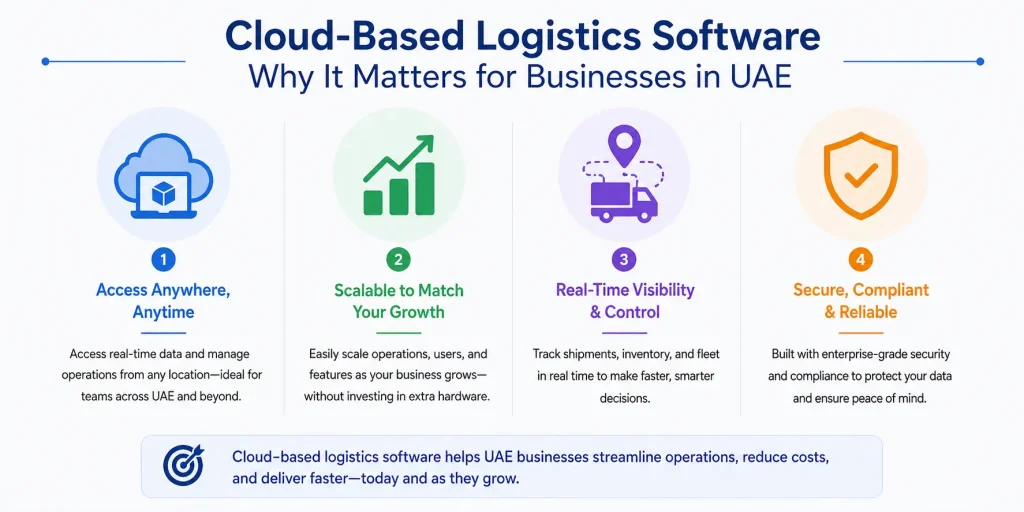
Why Cloud-Based Logistics Software UAE Is Becoming Essential for Scalable Supply Chains
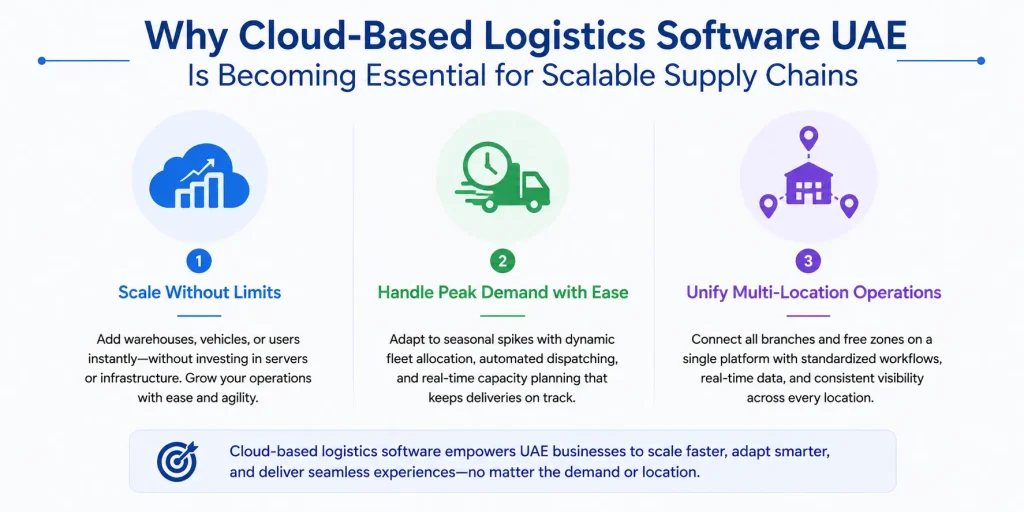
Scalability isn’t a nice-to-have anymore — for a lot of UAE logistics companies, it’s the deciding factor in whether an expansion plan actually works on paper. That’s precisely why demand for cloud-based logistics software UAE providers can scale on short notice has grown so sharply over the last two years.
Handling Business Growth Without Infrastructure Limitations
The old model meant that adding a warehouse, a new fleet of vehicles, or a batch of new users involved a fairly painful IT project. Servers had to be sized, licenses purchased, systems configured from scratch.
Cloud infrastructure removes most of that friction. Capacity expands as the business does, without a parallel infrastructure buildout running alongside it. A startup courier service and an enterprise 3PL can, in principle, run on the same cloud logistics platform UAE providers offer — the difference is in configuration and scale, not in needing an entirely separate system.
This is where cloud-based logistics software UAE teams see the value most concretely: a company can go from two warehouses to five without rebuilding its core operating system.
Managing Peak Demand With Elastic Logistics
Anyone who’s run fulfillment through Ramadan or the Dubai Shopping Festival knows the pattern: order volumes spike hard, delivery windows tighten, and fleets sized comfortably a month earlier suddenly feel too small.
Cloud systems handle this elasticity in a few specific ways:
- Dynamic fleet allocation that shifts vehicles toward the zones generating the most orders
- Automated dispatching that assigns drivers based on live capacity rather than a fixed morning schedule
- Real-time capacity planning that flags bottlenecks before they turn into missed delivery windows
The companies that handle peak season smoothly aren’t necessarily the ones with the biggest fleets — they’re the ones with the clearest real-time picture of what’s happening across it.
Supporting Multi-Location Logistics Operations
Running operations across Dubai, Abu Dhabi, Sharjah, and various free zones creates a coordination problem manual systems handle badly. Each location develops its own workarounds, its own spreadsheet formats, its own version of “how we do things here.”
A centralized cloud logistics platform UAE businesses run across every branch standardizes this. Every location works off the same data, the same workflows, and the same reporting structure — which means head office actually gets a real answer when it asks how a specific warehouse is performing, instead of three conflicting reports pulled together the night before a meeting. Standardizing workflows this way is also one of the more overlooked ways to reduce logistics operational bottlenecks that quietly build up between disconnected branches.
Key Features Businesses Need in Cloud Logistics Software in 2026
Not every platform sold as cloud-based logistics software UAE actually earns the label. Here’s what actually separates a functional system from a genuinely useful one — the set of essential logistics platform features worth checking before signing a contract.
Real-Time Shipment and Fleet Visibility
This is the baseline for any cloud-based logistics software UAE platform, not a differentiator. GPS tracking, live shipment status updates, driver monitoring, and automated customer notifications should all be standard.
The business impact is straightforward: customers who can see exactly where their order is complain less and trust the brand more. Internally, dispatchers who can see live fleet positions make faster, better rerouting decisions than ones working off a status update from an hour ago. It’s one of the first things buyers evaluating logistics software Dubai vendors tend to ask about in a demo — and rightly so.
AI-Powered Route Optimization and Automated Dispatch
Dubai traffic doesn’t care about a delivery SLA. This is exactly the kind of problem AI route optimization for logistics was built to solve — factoring in live traffic conditions, delivery windows, and vehicle capacity to plan routes that a human dispatcher, working from memory and instinct, simply can’t calculate as fast or as accurately.
The downstream effects compound: fewer failed delivery attempts, measurably lower fuel spend, and drivers who aren’t stuck idling in traffic they could have avoided. For fleets running dozens of daily routes, this alone can be one of the more direct ways to reduce logistics operational bottlenecks without adding a single new vehicle.
Cloud TMS Software for Transportation Management
A transportation management system is the operational core of most logistics platforms, and cloud TMS software has become the default over on-premise versions for a simple reason: it updates continuously and connects to carrier and customer systems without a manual data pull. For most fleet-heavy businesses, this single module is where cloud-based logistics software UAE adoption starts before expanding to warehousing and last-mile.
A solid cloud TMS software setup within cloud-based logistics software UAE handles freight planning, carrier selection and management, shipment scheduling, cost tracking, and delivery performance reporting — all from one interface, rather than four disconnected tools that each own a piece of the puzzle. Transportation companies increasingly default to cloud TMS because it removes the lag between something happening on the road and someone in the office finding out about it.
UAE Compliance and Integration Capabilities
This is where a lot of generic, imported cloud-based logistics software UAE platforms fall short. A system built for the US or European market often has no concept of FTA VAT requirements, UAE customs workflows, or Mirsal II integration for cross-border shipments.
Local compatibility isn’t a minor checkbox — it’s often the difference between a platform that works out of the box and one that needs months of custom patching. Anyone evaluating logistics software Dubai vendors should ask directly about UAE data protection compliance and existing ERP and carrier API integrations before signing anything. If the vendor can’t answer specifically, that’s worth noting.
Benefits of Cloud Logistics Software for UAE Businesses
The benefits of cloud logistics software tend to get summarized as “efficiency” in most articles, which is technically true but not particularly useful. Here’s what it actually looks like in practice for a business running cloud-based logistics software UAE-wide.
Improved Operational Efficiency
Automation removes a lot of the manual back-and-forth that used to eat up a warehouse manager’s morning on a cloud-based logistics software UAE dashboard. Fewer status-update emails, fewer “where’s my shipment” phone calls, faster handoffs between teams, and better coordination across operations help businesses improve supply chain efficiency. Decisions that used to wait for an end-of-day report can happen the moment the data updates.
Better Supply Chain Visibility
Instead of pulling data from five different systems to answer one question, cloud-based logistics software UAE teams get everything on a single dashboard. Real-time analytics flag problems while they’re still small, and predictive insights give planning teams a head start rather than a rear-view mirror. Customers benefit too — accurate ETAs build trust in a way that vague “your order is on its way” messages never do.
Reduced Logistics Costs
This is where cloud-based logistics software UAE numbers get concrete. Optimized routing cuts fuel usage. Fewer failed deliveries mean fewer redelivery attempts, which are expensive every time they happen. Better visibility into fleet utilization means fewer vehicles sitting idle while others are overbooked. None of this is theoretical — it shows up directly on a monthly operating statement.
Faster Business Expansion
Onboarding a new location on a cloud-based logistics software UAE platform is a configuration task, not a six-month infrastructure project. User accounts, permissions, and workflows can be replicated for a new warehouse or a new city in days rather than quarters. For a business that wants to move fast when a growth opportunity opens up, that speed is often the actual competitive edge — not the software features themselves.
How Cloud Logistics Platforms Are Transforming UAE Logistics Operations in 2026
Moving Beyond Traditional Logistics Management
The contrast is worth spelling out plainly. Traditional systems run on manual spreadsheets, offer limited visibility beyond a single team’s view, and produce reports that are outdated by the time anyone reads them. Cloud platforms replace that with automation, AI-driven insights, and real-time collaboration across teams that used to work in silos.
Connecting the Entire Supply Chain Ecosystem
The more interesting shift is what happens when suppliers, warehouses, transport providers, customers, and customs systems all connect through the same platform. At that point, the cloud logistics platform UAE business relies on stops being “software the logistics team uses” and becomes the connective infrastructure for the whole operation — closer to what people actually mean by Digital Supply Chains, not just a digitized version of the old paper process.
A digitized paper process still moves at the speed of its slowest manual step. A connected supply chain moves at the speed of its slowest data update — done right, that’s close to instant.
Challenges UAE Businesses Face When Adopting Cloud Logistics Software
Adopting cloud logistics technology isn’t always a frictionless process. One of the biggest challenges is integrating new platforms with legacy ERP systems, carrier APIs, and warehouse technologies that were never designed to work together. Businesses should carefully evaluate a platform’s integration capabilities before implementation to avoid costly delays and operational disruptions.
Data security and compliance are also major considerations. As operational data moves to the cloud, businesses need confidence in data protection, access controls, and compliance with UAE regulations rather than relying on generic security claims from vendors.
Another common challenge is employee adoption. Even the most advanced cloud-based logistics software UAE platform will struggle to deliver value if employees are not comfortable using it. Investing in user-friendly software, structured training, and effective change management helps ensure a smoother transition and better long-term results.
How to Choose the Right Cloud-Based Logistics Software UAE Solution
Choosing the right logistics platform starts with evaluating whether the provider understands UAE logistics operations. Check their experience with free zone workflows, customs processes, regional carrier networks, and local compliance requirements instead of choosing a generic global solution.
Scalability and integration capabilities are equally important. Look for strong API support, ERP integrations, carrier connections, and multi-location functionality to ensure the platform can support future business growth.
Businesses should also prioritize automation and analytics features such as AI capabilities, predictive insights, reporting dashboards, and automated workflows. For operations with unique requirements, working with a provider offering Custom Logistics Software Development in Dubai can help create a more tailored solution.
Future of Cloud-Based Logistics Software UAE: What Businesses Should Expect After 2026
The future of logistics will be driven by AI-powered supply chain intelligence, where predictive demand planning becomes a core operational capability rather than just an additional dashboard feature. Modern platforms will help businesses make faster decisions around inventory management, fleet allocation, and resource planning based on real-time insights.
Autonomous and connected logistics will also continue gaining momentum. IoT tracking, smart warehouses, and EV fleet integration will become more common as businesses focus on improving visibility, reducing costs, and achieving sustainability goals through cloud-based logistics software UAE platforms.
The next generation of logistics platforms will become more industry-specific, designed around UAE regulations, regional workflows, and local operational challenges from the beginning. This approach will help businesses adopt solutions that truly match their requirements instead of relying on generic platforms that require constant customization.
Final Thoughts
UAE logistics isn’t just digitizing old processes — it’s being rebuilt around real-time data, automation, and platforms designed for how this region actually operates. The businesses treating cloud adoption as a strategic shift, not just a software swap, are the ones positioned to scale smoothly through growth spurts and peak seasons alike.
The takeaway is simple: technology alone won’t fix a fragmented supply chain. What matters is choosing a platform built for UAE’s specific compliance, integration, and operational realities — one that grows with the business instead of holding it back.
Companies that get this right in 2026 won’t just run more efficient operations. They’ll be the ones ready to capture the next wave of regional logistics growth before their competitors catch up.
Looking to modernize your logistics operations with a scalable cloud solution? Partner with experienced logistics software experts to build a platform tailored to your UAE business requirements.
FAQs
Is cloud-based logistics software actually worth it for a small logistics business in the UAE, or is it overkill?
Yes — even small fleets benefit from real-time tracking and automation. Cloud platforms scale with usage, so smaller businesses pay for only what they need while avoiding costly on-premise infrastructure.
What’s the real difference between a cloud TMS and a regular logistics app?
A cloud TMS specifically manages transportation — freight planning, carrier selection, and shipment scheduling — while broader logistics apps often only cover tracking or delivery notifications, not full transport operations.
How hard is it to integrate cloud logistics software with an existing ERP system in the UAE?
It depends on the vendor. Platforms with pre-built ERP and carrier API connectors integrate in weeks; generic global platforms often need months of custom development to work smoothly.
Does cloud logistics software help with UAE customs and VAT compliance, or is that separate?
Good platforms include it. Look for built-in FTA VAT handling and Mirsal II customs integration — without these, you’re still managing compliance manually outside the system.