


Key Takeaways
- Dubai’s rapid logistics growth under D33 is creating operational bottlenecks — delays, errors, and rising costs that compound as companies scale.
- Bottlenecks rarely show up as one big failure; they show up as manual approvals, duplicate data entry, inventory mismatches, and rising complaints.
- Root causes: disconnected ERP/WMS/TMS systems, manual customs paperwork, poor real-time visibility, experience-based routing, and warehouse congestion.
- Smart logistics software fixes this by unifying systems, automating documentation, adding AI-powered routing, and giving real-time control tower visibility.
- Reducing bottlenecks is a 5-step process: identify delays → integrate systems via APIs → automate manual tasks → predict issues with AI → monitor with real-time analytics.
- Benefits include faster customs clearance, better fleet utilization, lower costs, improved customer experience, and easier scalability.
- Digital transformation is no longer optional — it’s a competitive necessity as customer expectations and GCC trade volumes rise.
- Choosing the right software partner matters more than the feature list — look for real UAE logistics expertise, API flexibility, and local compliance support.
Dubai’s logistics sector isn’t just growing — it’s being pushed to grow, fast, under the weight of the D33 agenda and the emirate’s ambition to become one of the world’s top four logistics hubs. New free zones, new trade corridors, new e-commerce volumes. All of it sounds like good news, and mostly it is.
But growth has a side effect nobody puts on the pitch deck: complexity. More shipments, more warehouses, more vehicles, more customs paperwork, more GCC border crossings. And underneath all that complexity, operational bottlenecks in Dubai logistics are quietly becoming one of the biggest threats to profitability, delivery timelines, and customer trust.
This article breaks down why these bottlenecks happen, what they cost you, and how smart logistics software — the kind built for the specific realities of UAE trade — closes the gap between scaling fast and scaling smart. By the end, you’ll know exactly which signals point to a bottleneck in your own operation, what’s usually causing it, and the concrete steps other Dubai-based logistics companies have taken to fix it without pausing operations for months.
Understanding Operational Bottlenecks in Dubai Logistics
A bottleneck, in plain terms, is any point in your operation where work piles up faster than it can move forward. In a UAE logistics business, that could be a customs desk waiting on a manually typed manifest, or a warehouse team re-keying the same order into three different systems.
Operational bottlenecks in Dubai logistics rarely show up as one dramatic failure. They show up as a hundred small delays that quietly compound — a shipment that takes six hours longer than it should, a driver circling a free zone because his routing sheet is a day old.
Why Logistics Operations Become Slower as Companies Scale
Scaling a logistics business in the UAE means juggling growing shipment volumes, multiple warehouses spread across emirates, an expanding fleet, tighter customs coordination, and cross-border GCC operations that all move on different timelines. Each of these, on its own, is manageable. Stack them together without a unified system, and the cracks start to show.
A three-truck operation can run on spreadsheets and WhatsApp groups. A thirty-truck operation with two warehouses and a customs desk cannot — not without something breaking.
Take a mid-sized freight forwarder moving from one Jebel Ali warehouse to two sites, one in Dubai and one in Sharjah. Overnight, the same manual stock-check process that took twenty minutes now needs to happen twice, on two separate spreadsheets, reconciled by hand at the end of each shift. Nothing about the process itself changed. It just stopped being able to keep up.
Common Signs Your Logistics Business Has Operational Bottlenecks
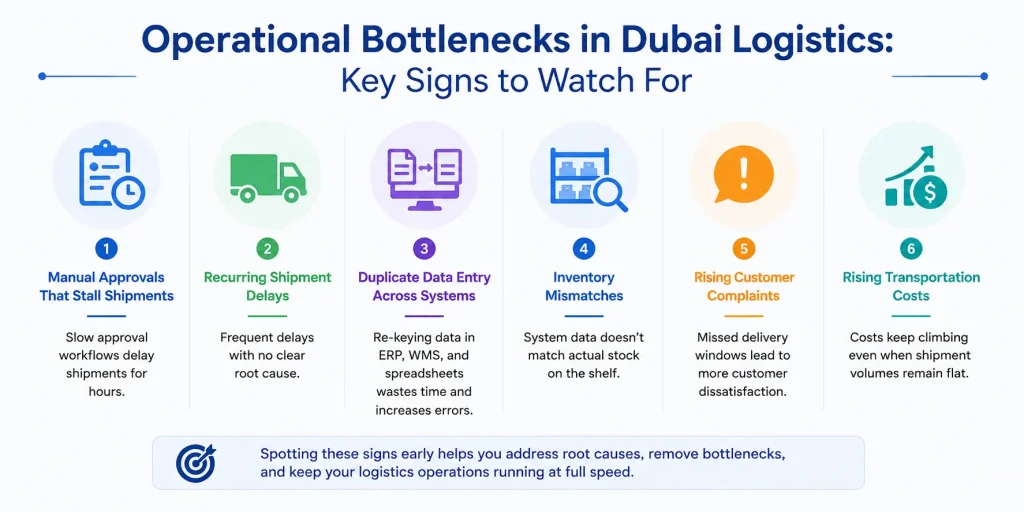
Most operators don’t wake up one day and diagnose a bottleneck. It reveals itself gradually, through:
- Manual approvals that stall shipments for hours
- Recurring shipment delays with no clear root cause
- Duplicate data entry across ERP, WMS, and spreadsheets
- Inventory mismatches between what the system says and what’s on the shelf
- Rising customer complaints about missed delivery windows
- Transportation costs that keep climbing even as volumes stay flat
If two or three of these sound familiar, you’re not dealing with a one-off problem. You’re dealing with a systemic bottleneck.
The Biggest Causes of Operational Bottlenecks in Dubai Logistics
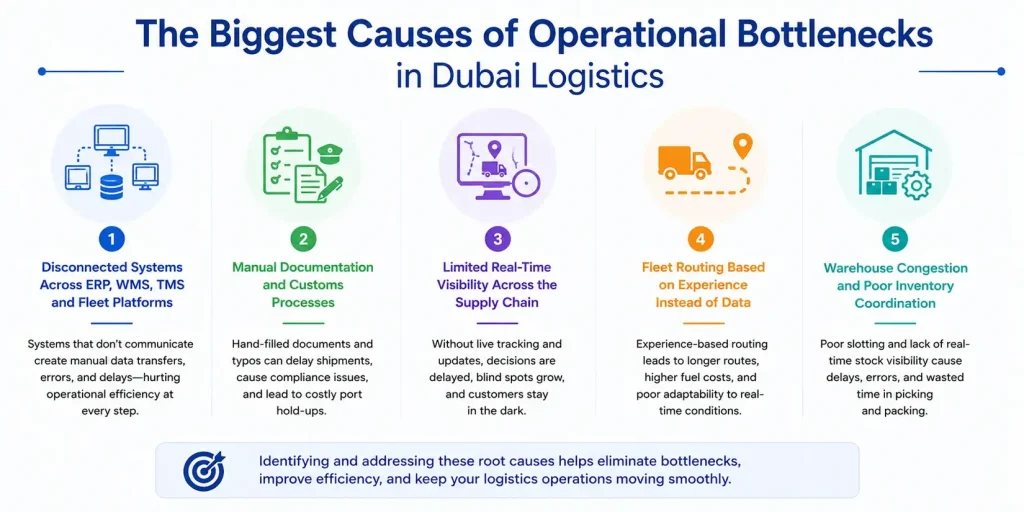
Most operational bottlenecks in Dubai logistics trace back to a handful of root causes — and once you see them clearly, they’re fixable. Interestingly, most of these causes overlap heavily with the common logistics software mistakes operators make when they try to patch the problem with more spreadsheets instead of an actual system fix.
Disconnected Systems Across ERP, WMS, TMS and Fleet Platforms
This is the big one. When your ERP, warehouse management system, transport management system, and fleet tracking tool don’t talk to each other, someone has to be the human API — copying numbers from one screen to another, hoping nothing gets lost in translation. This is where operational efficiency in logistics Dubai takes its biggest hit, because every disconnected system adds another point where errors and delays creep in.
Ask a warehouse manager how many separate logins their team uses in a single shift, and the number is often higher than they’d like to admit — one for stock, one for dispatch, one for invoicing. Each handoff between those systems is a chance for a number to get typed wrong, and a wrong number at 4 p.m. can mean a truck leaves half-loaded the next morning.
Manual Documentation and Customs Processes
Bills of lading, manifests, customs declarations, free-zone paperwork — UAE logistics still runs on a mountain of documents, and a lot of that mountain is filled in by hand. One typo on a manifest can hold a container at the port for a day. Multiply that across hundreds of shipments a month and the cost adds up fast.
Limited Real-Time Visibility Across the Supply Chain
Without live tracking, you’re managing blind spots, not shipments. Dispatchers make decisions based on where a truck was an hour ago, not where it is now. Customers ask for updates you don’t actually have. By the time a delay becomes visible, it’s already too late to route around it.
Fleet Routing Based on Experience Instead of Data
Plenty of dispatchers still route by memory and gut feel — which driver “usually” handles Jebel Ali, which road is “probably” clear. It works, until it doesn’t. Experience-based routing burns fuel on empty miles, misses faster routes, and can’t adapt in real time when Sheikh Zayed Road backs up.
Warehouse Congestion and Poor Inventory Coordination
A warehouse without proper slotting logic or real-time stock visibility turns picking and packing into a scavenger hunt. This is usually where a genuine warehouse management system implementation pays for itself within months, simply by cutting the time staff spend searching instead of shipping.
How Smart Logistics Software Improves Efficiency Across Logistics Operations
Here’s the part that actually moves the needle: how smart logistics software improves efficiency isn’t about adding more tools. It’s about replacing five disconnected tools with one that actually understands how UAE logistics works.
One Integrated Platform Instead of Multiple Disconnected Systems
A properly built platform pulls your ERP, WMS, TMS, CRM, and accounting into a single source of truth. No more re-typing the same order three times. No more reconciling numbers between systems at month-end. Everyone — dispatch, warehouse, finance — is looking at the same live data. Naturally, this is where good logistics software features matter most: integration depth, not just a longer feature list.
AI-Powered Route Optimization and Predictive ETAs
Dynamic routing engines factor in live traffic, driver availability, and delivery windows to build routes that a human dispatcher simply can’t calculate fast enough by hand. Predictive ETAs mean customers get accurate updates instead of best guesses, and fleet utilization climbs because trucks aren’t running half-empty on wasted routes.
Intelligent Document Processing for Customs Automation
OCR and AI-driven document processing read a bill of lading or customs form in seconds, flag inconsistencies before they reach a customs officer, and push clean data straight into your system. What used to take a clerk twenty minutes now takes the software about as long as it takes to upload the file.
Real-Time Logistics Visibility Through Control Tower Dashboards
A control tower dashboard gives you live tracking, exception alerts, and a single view of every shipment in motion. When something goes wrong, you find out the moment it happens, not the moment a customer calls to complain. That single shift — from reactive to proactive — is often the difference between a delay and a missed SLA.
For a dispatcher managing forty active deliveries at once, that difference isn’t small. Instead of fielding fifteen “where is it” calls an hour, they’re watching a map that already flags the two shipments running behind schedule, with enough time left to actually do something about it.

How to Reduce Logistics Bottlenecks Using Smart Software
Knowing how to reduce logistics bottlenecks in theory is one thing. Doing it in a live operation is another. The most successful logistics companies don’t try to solve every challenge at once—they take a structured, data-driven approach. Here’s a practical roadmap.
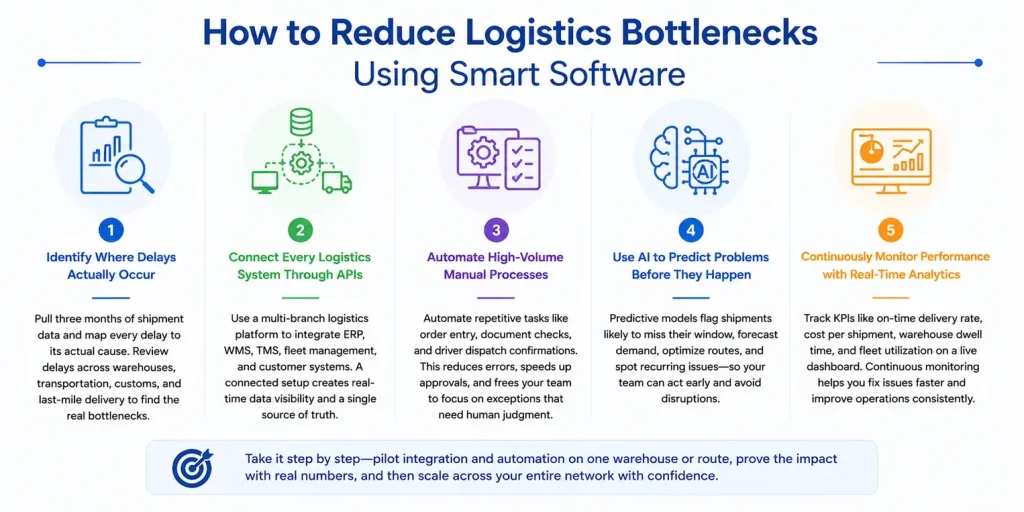
Step 1: Identify Where Delays Actually Occur
Pull three months of shipment data and map every delay to its actual cause — not the assumed one. Most companies are surprised to find the real bottleneck isn’t where they thought it was. Review delays across warehouses, transportation, customs, and last-mile delivery to understand which issues have the biggest operational impact.
Step 2: Connect Every Logistics System Through APIs
Integration comes before automation. If you’re running operations across several branches or emirates, a proper multi-branch logistics platform gives every location the same real-time data instead of forcing each site to run its own disconnected setup. Connecting ERP, WMS, TMS, fleet management, and customer systems creates a single source of truth for faster decision-making.
Step 3: Automate High-Volume Manual Processes
Start with the processes that happen hundreds of times a day — order entry, document checks, driver dispatch confirmations. Automating these frees up your team for the exceptions that actually need human judgment. It also reduces human errors, speeds up approvals, and improves consistency across daily operations.
Step 4: Use AI to Predict Problems Before They Happen
Predictive models can flag a shipment likely to miss its window while there’s still time to fix it, instead of after the customer has already noticed. AI can also forecast demand, optimize routes, and identify recurring operational patterns, helping teams make proactive decisions instead of reacting to disruptions.
Step 5: Continuously Monitor Performance with Real-Time Analytics
Track on-time delivery rate, cost per shipment, warehouse dwell time, and fleet utilization on a live dashboard. What gets measured continuously gets fixed continuously—bottlenecks that would’ve taken months to notice get caught in days. Regularly reviewing these KPIs helps logistics companies refine workflows and improve operational performance over time.
These five steps don’t need to happen in one giant rollout either. Most Dubai logistics operators see the clearest results by piloting the integration and automation steps on a single warehouse or route first, proving the impact with real numbers, then rolling it out across the rest of the network with far less internal resistance. This phased approach reduces implementation risks, encourages user adoption, and makes digital transformation more manageable for growing logistics businesses.
Smart Logistics Software Benefits for Dubai Logistics Companies
The smart logistics software benefits show up fastest in the numbers that matter to a logistics company’s bottom line. These platforms help businesses improve efficiency, reduce costs, and build the flexibility needed to grow in Dubai’s competitive logistics market.
Faster Customs Clearance
Automated, error-checked documentation means fewer holds at the border and fewer clarification calls with customs officers. By reducing manual paperwork and validating documents before submission, businesses can speed up customs clearance while minimizing compliance errors.
Better Fleet Utilization
AI routing keeps trucks fuller and routes tighter, cutting empty miles and fuel spend. Real-time route optimization helps dispatchers improve delivery schedules, reduce idle time, and make better use of fleet resources.
Improved Warehouse Productivity
Real-time inventory visibility turns picking from a search exercise into a straight line from shelf to truck. Accurate inventory data reduces picking errors, speeds up order fulfillment, and supports successful warehouse management system implementation for more efficient warehouse operations.
Lower Operating Costs
Less manual rework, fewer errors, less fuel waste — the savings compound month over month. While many businesses compare logistics software pricing in UAE before investing, the right platform delivers long-term value by automating routine processes, improving resource utilization, and significantly reducing overall operating costs.
Better Customer Experience
Accurate ETAs and proactive delay alerts turn “where’s my shipment” calls into a rare exception instead of a daily routine. Real-time shipment updates improve communication and help build stronger customer trust.
Higher Business Scalability
A platform that scales with you means the next warehouse, the next fleet expansion, or the next GCC route doesn’t require rebuilding your systems from scratch. Adding a new branch becomes a configuration change instead of a lengthy IT project, making expansion faster and more manageable while supporting long-term digital logistics transformation.
Why Digital Logistics Transformation Is Becoming a Competitive Necessity in Dubai
Under Dubai’s D33 economic agenda, logistics is positioned as a core pillar of the emirate’s growth — and that’s pulling every operator in the sector toward faster AI adoption, whether they’re ready or not. E-commerce volumes keep climbing, GCC cross-border trade keeps expanding, and customers now expect Amazon-level tracking from a regional freight company.
Digital logistics transformation isn’t a nice-to-have anymore; it’s the baseline customers and partners expect. Sustainability targets are adding pressure too — route optimization and fleet efficiency aren’t just cost savers now, they’re part of meeting emissions commitments. Companies that put off modernizing are competing on price and hustle alone, against rivals competing on data.
That gap tends to widen fast in a market like Dubai’s, where a new competitor entering with a fully digital operation can undercut both price and delivery speed within the first year, simply because they’re not carrying the overhead of manual processes. For operators mapping out where to start, a solid logistics software UAE guide covering the local regulatory and infrastructure specifics is usually the fastest way to avoid an expensive false start.
Choosing the Right Smart Logistics Software Partner
Picking a platform is less about the feature checklist and more about whether the vendor actually understands UAE logistics.
Look Beyond Software Features
Look for real UAE logistics expertise, not a generic global platform retrofitted for the region. Confirm the system supports open API integrations, runs on cloud-native architecture, and has genuine AI capabilities — not AI as a marketing label. Ask how it scales as you add branches or vehicles, how it handles UAE-specific compliance and customs formats, and what ongoing support actually looks like after go-live.
A vendor demo can make almost any platform look impressive. The real test is asking them to walk through a scenario specific to your operation — a Jebel Ali free-zone shipment, a multi-emirate delivery run — and watching whether they can actually show you, not just describe, how the system handles it.
If your current systems are already straining, it’s worth talking to a team that specialises in Custom Logistics Software Development in Dubai rather than forcing a generic, off-the-shelf tool to fit a business it wasn’t built for.
Conclusion
Manual processes and disconnected systems can carry a logistics business only so far. Past a certain size, they stop being an inconvenience and start being the reason shipments run late, costs creep up, and customers look elsewhere. That’s the real story behind operational bottlenecks in Dubai logistics — they’re not a staffing problem or a bad-luck problem, they’re a systems problem.
Integrated, AI-enabled logistics platforms fix that at the root: one source of truth instead of five disconnected ones, live visibility instead of guesswork, and automation handling the repetitive work so your team can handle the exceptions. The result is faster clearance, tighter fleet utilization, lower costs, and a business that can actually scale.
If your operations are starting to feel the strain, the smartest move is to talk to a team that builds logistics software around how Dubai’s supply chains actually work — not a generic template. Get in touch to see what a platform built for your operation could look like.
FAQs
What are the most common operational bottlenecks in Dubai logistics?
The most frequent operational bottlenecks in Dubai logistics are disconnected systems between ERP, WMS, and TMS platforms, manual customs documentation, poor real-time shipment visibility, and warehouse congestion caused by weak inventory coordination.
How smart logistics software improves efficiency in logistics companies?
It replaces manual, disconnected processes with one integrated platform, automates document-heavy tasks like customs paperwork, and uses AI for route optimization and predictive ETAs — cutting delays and rework across the operation.
What is the role of warehouse management system implementation in reducing delays?
A proper WMS gives real-time inventory visibility and smart slotting logic, so staff spend less time searching for stock and more time picking, packing, and shipping — directly reducing warehouse-level delays.
Is digital logistics transformation suitable for mid-sized logistics companies in Dubai?
Yes. Modern platforms are built to scale with the business, so mid-sized operators can start with core modules — routing, documentation, visibility — and expand as volumes and branch count grow, without needing an enterprise-level budget from day one.