


Key Takeaways
- Trust — not payment UX — is the biggest barrier to adoption in Islamic charity apps
- Donors mentally vet campaigns before giving: legitimacy, verification, religious compliance, fund destination
- Religious compliance (Zakat rules, Sadaqah guidelines, donation categorization) must be built into the product structure, not added as an afterthought
- Four recurring trust gaps: lack of transparency, weak charity/campaign verification, data security concerns, mismatched cultural/religious expectations
- Core trust-building features: verified charity profiles, real-time donation tracking, Zakat calculator, secure/multiple payment options, multilingual UX, AI-driven fraud detection and personalization
- Blockchain, AI, and cloud infrastructure reinforce transparency, fraud prevention, and scalability during donation peaks (e.g., Ramadan)
- Development cost is driven mainly by how much of the trust/verification feature set is built in early, plus platform choice and ongoing maintenance
- Post-donation follow-up (impact reports, updates) is what turns one-time donors into repeat donors
- Future trends: AI charity assistants, blockchain transparency, smart Zakat platforms, embedded donations
- Winning platforms will compete on trust, accountability, and personalization — not just design polish
Digital giving has exploded over the last few years. People no longer wait for Ramadan collection boxes or a knock at the door from a local mosque volunteer — they open an app, tap a few times, and their Zakat or Sadaqah is on its way. Mobile giving now accounts for a growing share of charitable donations worldwide, and Islamic charity platforms are riding that same wave.
But here’s the catch: a smooth checkout flow isn’t enough. Islamic charity app development carries a burden that a typical eCommerce or fintech app doesn’t have to think about — donors aren’t just buying something, they’re placing their faith, their money, and their religious obligations in the hands of a piece of software.
Before someone donates, they’re silently asking a string of questions. Is this charity real? Is my Zakat being calculated correctly? Will my money actually reach the people it’s meant for? Is this whole process even compliant with Islamic principles? If the app can’t answer those questions convincingly, no amount of clean design or fast payment processing will save it.
That’s the real challenge. Successful Islamic charity apps aren’t won on UI polish alone — they’re won on a combination of technology, religious compliance, and radical transparency. This piece walks through why trust is so hard to earn in this space, the specific trust gaps donors run into, the features that close them, and what it actually costs to build a platform people believe in.
Donors Need Proof Before They Donate
Charity is emotional, but it isn’t blind. Before someone commits even a small amount of money, they run through a mental checklist — often without realizing it.
Who’s actually running this campaign? Is the organization behind it verified, or is it just a name and a photo? Is the money going where it says it’s going? And critically for Muslim donors: does this align with how giving is supposed to work in Islam?
This is where charity platforms diverge sharply from regular shopping apps. If someone buys the wrong pair of shoes online, they return them and move on. If someone donates to a fake campaign, there’s no return policy — the money is gone, and so is their trust in every charity app they encounter afterward. That’s why charity platforms depend on emotional confidence and a sense of social responsibility in a way that retail apps simply don’t.
Religious Compliance Plays a Major Role in User Trust
For a large share of users, an Islamic charity app isn’t just a donation tool — it’s a religious instrument. That raises the bar considerably.
The app needs to get Zakat eligibility right: who qualifies to give, who qualifies to receive, and how the obligation is calculated based on different asset types. It needs to handle Sadaqah with the flexibility that voluntary giving requires. It needs fundraising practices that don’t cross ethical lines. And it needs donations sorted into the correct categories, because mixing Zakat funds with general Sadaqah funds isn’t just a UX inconvenience — it’s a religious error.
When any of this is vague or unclear, donors hesitate. And hesitation, in a donation flow, usually means abandonment. This is exactly why an Islamic charity app development guide worth following always starts with scholars and compliance experts in the room, not just designers and developers.
Too many teams treat religious compliance as a content problem — write some FAQ pages, add a disclaimer, done. It’s actually a product problem. Zakat categorization needs to be baked into the database schema, not bolted on as a label. Sadaqah campaigns need different approval logic than Zakat-eligible ones. Get this structural work right early, and every feature built on top of it — calculators, reports, receipts — inherits that accuracy automatically. Get it wrong, and you’ll be retrofitting the entire donation model later, usually after a scholar or a user flags the mistake publicly.
Key Trust Challenges Faced by Islamic Charity Apps
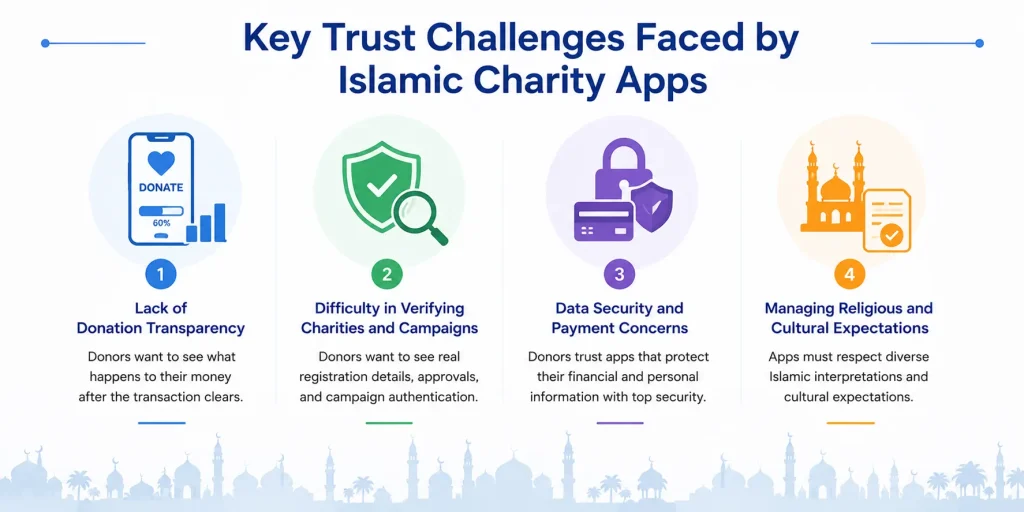
Lack of Donation Transparency
A payment confirmation screen used to be enough. It isn’t anymore. Donors want to see what happens to their money after the transaction clears.
That means:
- Donation tracking that shows progress in real time
- Campaign updates as milestones are reached
- Fund allocation reports breaking down where money actually went
- Beneficiary impact stories that put a human face on the numbers
Apps that only show “Thank you for your donation” and nothing else are leaving donors in the dark. Apps that show the complete journey — from tap to impact — build relationships that survive past a single gift.
Think about the difference between two donors giving to the same water-well campaign. One gets a payment receipt and never hears from the charity again. The other gets a notification three weeks later showing the well is 60% funded, a photo update once construction starts, and a final message with GPS coordinates and a completion date. Only one of those two donors is likely to give again next year, and it’s not the one who got silence.
Difficulty in Verifying Charities and Campaigns
Anyone can launch a fundraising campaign online. That openness is part of what makes digital giving powerful, but it’s also exactly why verification matters so much.
Donors want to see organization profiles with real registration details, regulatory approvals, and some form of campaign authentication before they trust a “Donate Now” button. When platforms skip this step, fake campaigns slip through, misuse concerns spread, and adoption stalls — because one bad headline about a scam charity app can undo months of goodwill for every legitimate platform in the category.
Data Security and Payment Concerns
Donors are handing over financial details and, often, personal identity information. If that data isn’t locked down, nothing else about the app matters.
This means encrypted payment gateways, fraud prevention mechanisms that catch suspicious activity before it becomes a problem, and airtight protection of donor information end to end. Cybersecurity isn’t a background technical concern here — it’s a direct, visible driver of whether someone trusts the app with their money in the first place. This is one of the biggest reasons charity organizations in the region increasingly turn to secure app development services UAE providers that specialize in financial-grade compliance, rather than general-purpose app studios.
Managing Religious and Cultural Expectations
Islamic giving isn’t monolithic. Different schools of thought interpret certain categories differently, and users bring different regional and cultural expectations to the table. An app built without accounting for this will feel “off” to a meaningful portion of its audience — even if nothing is technically wrong.
The fix is expert-reviewed donation workflows, built with input from scholars who understand the nuance, not just developers translating a spec sheet into code. This is a core reason Islamic donation app development projects take longer and require more stakeholder input than a typical fintech build.
Essential Islamic Charity App Features That Build Donor Trust
Trust is not something that can be added later; it needs to be built into every part of a charity platform. Donors want more than a simple donation option — they need confidence that campaigns are verified, payments are secure, and their contributions are making a real impact.
These are some of the most important Islamic charity app features that help build transparency and long-term donor relationships.
Verified Charity and Campaign Profiles
Every charity organization and campaign should display clear verification details, registration information, and approval status before users make a donation. Visible trust indicators help donors understand who they are supporting and reduce concerns about fraudulent campaigns.
A strong verification system also improves credibility by creating a transparent connection between charities, donors, and beneficiaries.
Transparent Donation Tracking
Donation tracking features such as fund utilization reports, digital receipts, campaign updates, and impact notifications help donors see what happens after they contribute.
Instead of ending the journey after payment confirmation, these updates create ongoing engagement and encourage users to donate again by showing the real impact of their support.
Zakat Calculator and Religious Guidance
A reliable Zakat calculator can become one of the most valuable trust-building features in an Islamic charity app. It should help users calculate zakat based on different assets such as cash, gold, investments, and savings while providing clear guidance about the calculation process.
Organizations planning to build a Zakat calculator should focus on accurate nisab values, proper calculation methods, and expert-reviewed guidelines to ensure users receive trustworthy results.
Secure Payment and Multiple Donation Options
Secure payment processing is essential for donor confidence. Apps should support multiple payment methods, including digital wallets, bank transfers, and recurring donations, while ensuring transaction security and clear payment confirmation.
Multilingual User Experience
Supporting Arabic and English languages helps charity apps serve a wider audience. Simple navigation, accessible design, and clear donation categories make the experience easier for users from different backgrounds.
AI-Powered Trust and Personalization Features
AI can improve charity platforms by detecting suspicious activities, supporting campaign monitoring, and providing personalized donation recommendations. It can also automate donor updates and improve communication without reducing the importance of human verification.
Together, these features create a transparent and reliable donation experience where users feel confident about contributing to meaningful causes.
How Technology Can Improve Trust in Islamic Charity App Development
Technology is helping Islamic charity platforms solve one of their biggest challenges — building donor trust. Modern charity apps are not just focused on collecting donations; they need to provide transparency, security, and accountability throughout the donation journey. Technologies like blockchain, AI, and cloud infrastructure help create more reliable platforms where donors can confidently contribute.
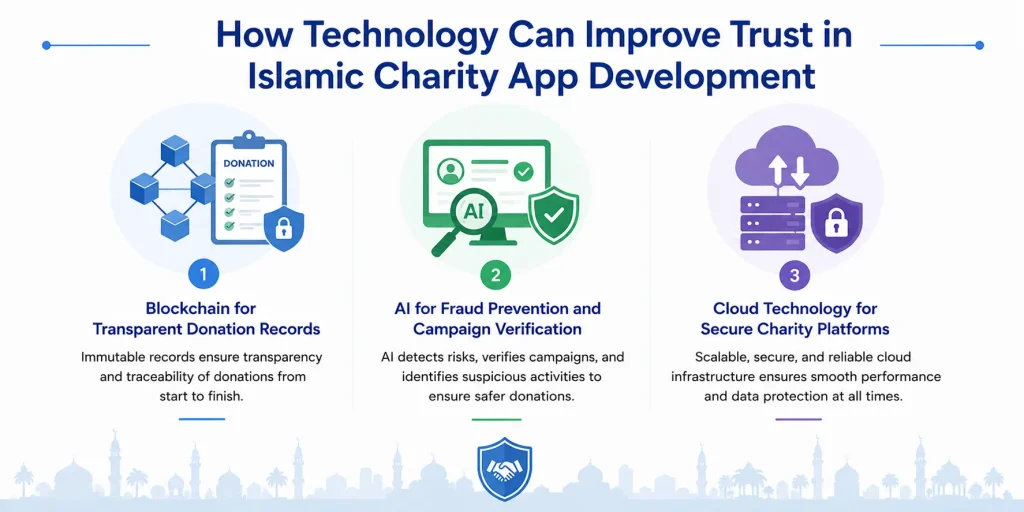
Blockchain for Transparent Donation Records
Blockchain technology creates an immutable record of donation transactions, meaning once information is recorded, it cannot be easily changed or manipulated. This improves fund traceability and helps donors understand how their contributions move through the system.
For Islamic charity platforms, blockchain can provide greater transparency by maintaining clear records of donations, approvals, and fund distribution. This level of visibility helps address one of the biggest donor concerns — knowing whether their money is reaching the intended cause.
By integrating blockchain into Islamic charity app development, organizations can build stronger accountability and create a more trustworthy digital donation experience. Businesses looking to implement secure and transparent blockchain solutions can partner with a blockchain development company in Dubai to develop reliable platforms with improved transaction visibility, data integrity, and better donor confidence.
AI for Fraud Prevention and Campaign Verification
Artificial intelligence can help charity platforms identify risks, verify campaigns, and improve fraud detection processes. AI-powered systems can analyze donation patterns, detect unusual activities, and highlight campaigns that require additional review.
In Zakat app development, AI can also support better categorization and provide personalized guidance while assisting charity teams with faster decision-making. However, AI works as a support tool and does not replace human verification or religious oversight.
By improving security and operational efficiency, AI helps create safer platforms where donors feel more confident about their contributions.
Cloud Technology for Secure Charity Platforms
Cloud infrastructure enables charity applications to handle increasing donation volumes, especially during periods like Ramadan and emergency campaigns when user activity can rise significantly.
Cloud platforms provide scalability, better data protection, automated backups, and reliable performance compared to traditional infrastructure. This ensures that donation platforms remain accessible and secure even during high-traffic periods.
For Islamic donation app development, cloud technology also makes it easier to integrate advanced features like analytics, payment systems, and real-time donation tracking while maintaining a secure user experience.
Factors Affecting Charity App Development Cost
Every charity organization eventually asks the same question: what’s this actually going to cost? The honest answer is “it depends” — but here’s what it depends on.
Features and functionality. A basic donation app with payment processing and a campaign list costs far less than one with advanced tracking systems, AI integration, a full Zakat calculator, and an admin dashboard for charity partners to manage their own campaigns.
Platform selection. iOS-only, Android-only, or cross-platform development all come with different cost profiles and different long-term maintenance implications.
Security and compliance requirements. Payment security, data protection standards, regulatory compliance (especially across multiple countries), and charity verification systems all add engineering time — but they’re non-negotiable given everything discussed above.
Maintenance and future upgrades. Security patches, feature improvements, and performance optimization don’t stop once the app launches. Budgeting only for launch and ignoring the ongoing cost is one of the most common mistakes charity organizations make.
If you’re trying to pin down a real number, get quotes based on your specific feature list rather than industry averages — Islamic charity app development cost varies wildly depending on how much of the trust-building feature set above you’re building in at launch versus adding later.
How to Build a Trust-First Islamic Charity App
Start With Compliance and Verification
Partner with verified charities from day one. Build approval workflows into the platform itself, not as an afterthought. Maintain regulatory standards as a baseline requirement, not a box to check before submission to the app store.
Design Transparency Into Every User Journey
Before donation: show campaign details and charity verification clearly, without making the donor hunt for them.
During donation: keep payments secure and give donors visible tracking from the moment they tap “Donate.”
After donation: follow up with impact reports and updates. This is the step most apps skip, and it’s the one that determines whether someone comes back.
Focus on Long-Term Donor Relationships
Personalized communication, recurring giving options, and genuine community engagement turn one-time donors into long-term supporters. A platform that only thinks about the next transaction will always be fighting for new users instead of retaining the ones it already has.
If you’re evaluating who builds this for you, working with an experienced mobile application development company in Dubai gives you the advantage of a team that already understands both the regional regulatory landscape and the cultural expectations of Gulf donors — two things a generalist agency elsewhere often has to learn on your dime.
Future Trends in Islamic Charity App Development
The next generation of Islamic charity platforms is already taking shape. AI-powered charity assistants will help donors decide where and how much to give. Blockchain-based transparency will move from a nice-to-have to an expectation. Smart Zakat platforms will connect directly to bank and investment data (with permission) to calculate obligations automatically. Digital charity ecosystems will link multiple organizations under shared verification standards. And embedded donations — the ability to give directly from within a banking app or a shopping app at checkout — will make giving a background habit rather than a separate destination.
The platforms that win this next phase won’t be the ones with the flashiest interface. They’ll be the ones that compete on trust, accountability, and personalization — because that’s what donors have been asking for the whole time.
Conclusion
Technology enables donations. Trust is what drives adoption. Every donor opening a Zakat app is really asking four questions: is this charity legitimate, is this religiously compliant, is my money transparent, and is my data secure? Answer all four convincingly, and the technology stops being the hard part.
The future of Islamic charity app development belongs to platforms that turn a simple transaction into something bigger — a transparent, secure, and genuinely meaningful journey for both the donor giving and the beneficiary receiving. Get the trust layer right, and everything else about the app gets easier to build on top of it.
Frequently Asked Questions
What makes Islamic charity apps different from regular donation apps?
They must combine secure payments with religious compliance — Zakat eligibility, Sadaqah rules, and proper fund categorization — since donors are fulfilling a religious obligation, not just making a purchase.
How much does Islamic charity app development cost?
Cost varies by features, platform choice, and compliance requirements. Basic apps cost less; adding Zakat calculators, AI fraud detection, and verification systems increases the investment significantly
Why is a Zakat calculator important in these apps?
It gives donors accurate, asset-based calculations they can trust, backed by scholarly-reviewed methodology — turning a confusing religious obligation into a simple, confident donation decision
How can charity apps build donor trust long-term?
Through verified charity profiles, transparent donation tracking, secure payments, and post-donation impact updates — showing donors exactly where their money went, not just confirming the transaction.