


Key takeaways
- UAE logistics digital transformation is now central to enterprise strategy, driven by D33, the Commercial Transport Strategy 2030, and rising AI adoption.
- Fragmented systems (disconnected TMS/WMS/ERP) are the biggest barrier — integration is the real foundation of transformation.
- Automation alone isn’t transformation; it requires connected data, redesigned processes, and AI-assisted decisions.
- UAE-specific compliance (customs, VAT, free-zone workflows) makes localization essential, not optional.
- Success should be measured through operational, financial, and customer KPIs — not just software adoption.
- The key question for enterprises: can current technology support where the business is headed, not just where it is today.
UAE enterprises used to treat logistics automation as a back-office upgrade — swap a paper waybill for a PDF, call it done. That thinking is gone. By 2026, logistics sits at the center of enterprise digital transformation planning, not off in a corner owned by the warehouse team.
UAE logistics digital transformation now touches how a business plans inventory, prices last-mile delivery, tracks its carbon footprint, and talks to customers in real time. It’s tied directly to Dubai’s D33 Economic Agenda and the Commercial Transport Strategy 2030, both reshaping how freight moves across the country. Add faster AI adoption and explosive e-commerce growth, and it’s obvious why logistics can no longer operate in its own silo.
Yet a lot of enterprises still run on fragmented systems: a TMS that doesn’t talk to the WMS, spreadsheets tracking inventory that’s supposed to be “real-time,” and coordination happening over phone calls. These gaps are precisely what UAE logistics digital transformation is meant to close.
Modern logistics software connects operations, data, AI, compliance, customer experience, and sustainability into a single digital ecosystem — and it’s fast becoming the foundation enterprises build the rest of their transformation on. This article covers why that shift is accelerating, the real role logistics software for UAE enterprises plays, seven concrete ways it drives transformation, the trends worth watching this year, where the market still falls short, what to look for in a platform, and how to measure whether any of it is working.
Why UAE Enterprises Are Accelerating Logistics Digital Transformation in 2026
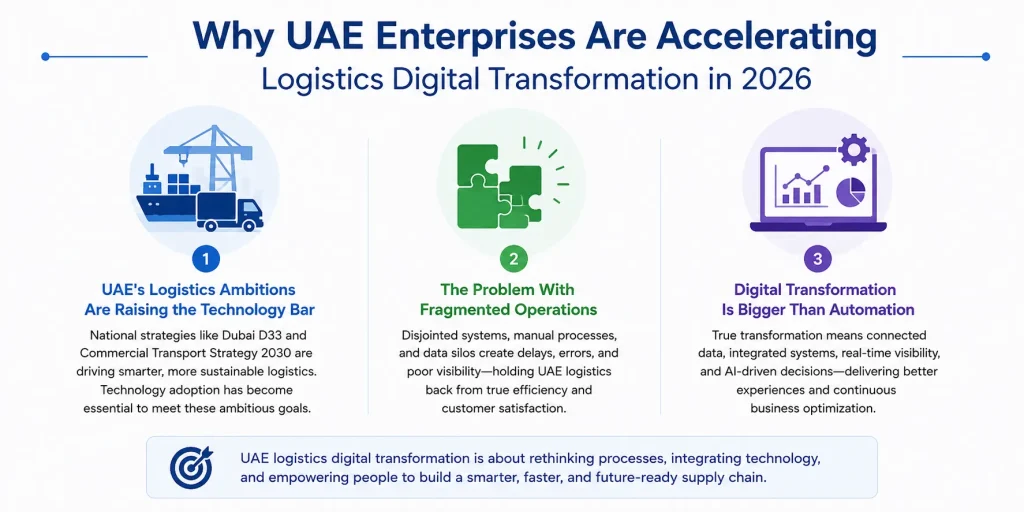
UAE’s Logistics Ambitions Are Raising the Technology Bar
The UAE isn’t trying to become a regional logistics hub — it already is one, sitting at the crossroads of Europe, Asia, and Africa with some of the busiest ports and air cargo operations in the world. Dubai’s D33 Economic Agenda puts logistics and trade among its core pillars, aiming to strengthen Dubai’s position as one of the world’s top logistics centers. The Commercial Transport Strategy 2030 pushes further, targeting smarter freight movement and lower emissions across commercial transport nationwide.
None of that happens on spreadsheets. When national strategy sets the bar this high, technology adoption stops being a nice-to-have. That’s the backdrop driving UAE logistics digital transformation right now — shaped by policy as much as by market pressure.
The Problem With Fragmented Logistics Operations
Walk into a mid-size UAE distributor’s operations office and you’ll usually find the same picture: a TMS handling road freight, a separate WMS running the warehouse, an ERP updated only at month-end, and a fleet system nobody outside the transport team ever opens. Customs documentation gets typed by hand, inventory counts live in a spreadsheet, and when a customer asks “where’s my shipment?” nobody can answer without checking three departments first.
These silos aren’t just inefficient. They cap how far UAE logistics digital transformation can actually go, because disconnected systems can’t produce the connected, real-time picture the whole strategy depends on.
Digital Transformation Is Bigger Than Automation
Automation isn’t the same thing as transformation. Automating a broken process just makes the broken process run faster. Genuine digital transformation in UAE logistics means connected data, redesigned processes, integrated systems, AI-assisted decisions, real-time visibility, digital customer experiences, and continuous optimization — not a one-time software rollout you check off a list.
UAE logistics digital transformation, done properly, is a combination of technology, process, people, and business strategy. Buying a platform and leaving old workflows untouched isn’t transformation — it’s just a more expensive version of the same problem.
What Role Does Logistics Software Play in UAE Enterprise Digital Transformation?
Creating a Single Digital Backbone for Logistics Operations
Modern logistics platforms are built to connect ERP, TMS, WMS, fleet management, customs, billing, CRM, and analytics into one shared data environment instead of eight disconnected ones. That integration is the actual mechanism behind UAE logistics digital transformation — not the software license itself, but what it makes possible once every system reads from the same data.
The payoff is concrete: less duplicate data entry, consistent numbers across departments, faster decisions, and centralized reporting instead of five different spreadsheets. Enterprises evaluating a custom logistics software development in Dubai approach often start here, since a backbone built around their actual workflows holds up better than a generic platform forced to fit.
Connecting Physical Logistics With Digital Decision-Making
Logistics software turns raw operational data — shipment status, vehicle location, inventory levels, ETA, fuel consumption, customs status, warehouse activity — into something a manager can act on. That’s the shift from reacting to problems after they’ve already cost money, to catching them early enough to prevent the cost altogether.
A dispatcher who sees a delivery running 40 minutes late can reroute before the customer notices. A planner who sees inventory trending toward a stockout can reorder before it becomes an emergency. That foresight is what separates digitized operations from truly transformed ones.
Turning Logistics Into an Enterprise-Wide Digital Capability
Logistics data doesn’t just belong to the logistics team. Procurement uses it to time purchase orders, sales uses it to set realistic delivery promises, finance tracks cost per shipment with it, and customer service answers “where’s my order” without calling the warehouse. Executive forecasting runs better with a live feed of what’s actually moving too.
The point enterprises tend to miss: logistics software shouldn’t operate as an isolated, department-level tool. When it does, UAE logistics digital transformation stalls at the warehouse door instead of spreading across the business.
7 Ways Logistics Software Supports UAE Logistics Digital Transformation
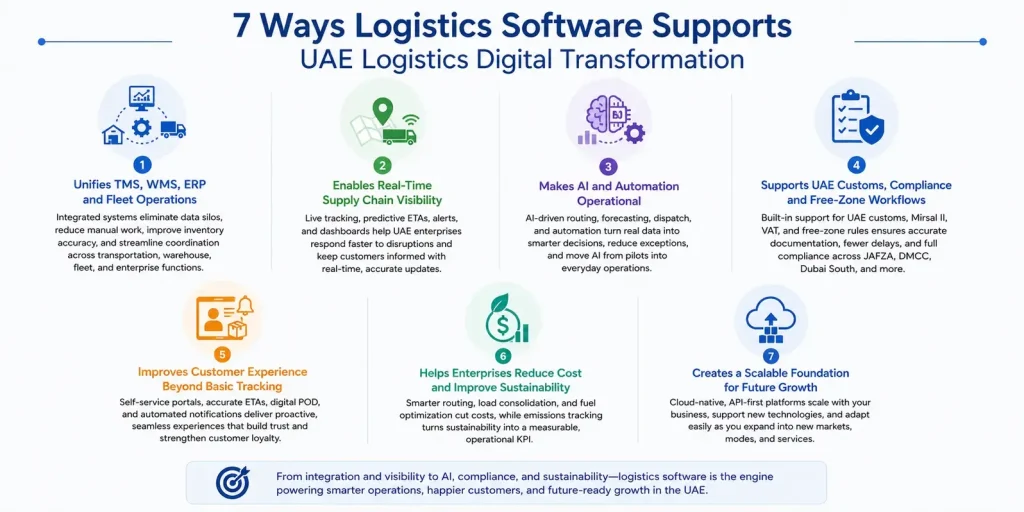
1. Unifies TMS, WMS, ERP and Fleet Operations
Integration is where most transformation projects take off or stall. When transportation, warehouse, fleet, and enterprise systems are connected, data moves automatically instead of getting re-typed at every handoff — fewer stock inconsistencies, better shipment coordination, and real inventory visibility instead of a best guess.
This is arguably the most foundational piece of UAE logistics digital transformation. Enterprises comparing enterprise logistics management software UAE options should treat integration depth as the first filter, not an afterthought.
2. Enables Real-Time Supply Chain Visibility
Live shipment tracking, GPS fleet monitoring, predictive ETAs, exception alerts, and customer-facing dashboards have moved from “nice extras” to baseline expectations. Real-time visibility lets a UAE enterprise respond to traffic on Sheikh Zayed Road, port congestion at Jebel Ali, or a sudden demand spike — instead of hearing about it a day later from an angry customer.
This is also where UAE logistics digital transformation becomes visible outside the logistics department, since visibility data feeds sales conversations, customer support, and executive dashboards.
3. Makes AI and Automation Operational
The conversation has moved past generic claims about “AI-powered logistics.” What matters now is what AI is actually doing: route optimization, predictive ETA calculation, demand forecasting, intelligent dispatching, automated documentation, and exception prediction before a shipment goes wrong.
AI only gets valuable once it’s connected to real operational data — a forecasting model fed clean, live numbers beats a fancier model fed stale spreadsheets every time. That’s the shift defining UAE logistics digital transformation in 2026: AI moving out of pilot projects and into daily operations.
4. Supports UAE Customs, Compliance and Free-Zone Workflows
This is where generic, imported logistics platforms tend to fall short. UAE enterprises deal with Dubai Customs procedures, Mirsal II declarations, VAT and e-invoicing rules, and free-zone-specific workflows across zones like JAFZA, DMCC, and Dubai South, plus re-export and transshipment operations common in a country built around trade.
International platforms built for other markets often don’t handle these rules out of the box. Logistics software for UAE enterprises needs to embed them directly — customs documentation formats, VAT logic, free-zone reporting — rather than forcing operations teams to work around the gaps manually. Done right, this cuts manual errors, documentation delays, and compliance risk.
5. Improves Customer Experience Beyond Basic Tracking
Customer expectations have moved through three stages fast: basic tracking, real-time visibility, and now a proactive digital experience where the customer barely has to ask. That means self-service portals, accurate ETAs instead of vague date ranges, automated delivery notifications, digital proof of delivery, and marketplace integrations for enterprises selling through third-party platforms.
The UAE’s e-commerce and B2B delivery expectations keep climbing, and customer-facing capability is where UAE logistics digital transformation stops being an internal story and becomes something customers actually notice.
6. Helps Enterprises Reduce Cost and Improve Sustainability
Route optimization, load consolidation, fewer empty trips, and fuel optimization all show up directly on the cost line. Sustainability no longer has to live only in an annual ESG report — shipment-level emissions and carbon tracking can now sit inside the same platform that’s already optimizing routes and fuel.
Connecting sustainability to cost, route, and delivery performance turns it into an operational KPI instead of a once-a-year disclosure exercise, which is exactly the kind of measurable outcome UAE logistics digital transformation is supposed to produce.
7. Creates a Scalable Foundation for Future Growth
An enterprise opening a new warehouse, entering a new delivery zone, or moving into multimodal and cross-border logistics needs a platform that can grow with it, not one that needs replacing every time the business changes shape.
Cloud-native, API-first architecture makes that possible — it’s what lets a platform absorb new IoT devices and AI integrations as they come along instead of forcing a rebuild. Understanding modern logistics platform features like these upfront separates technology that supports ongoing transformation from technology that becomes next year’s legacy problem.
Logistics Technology Trends UAE Enterprises Should Watch in 2026
These are the technology layers shaping the next stage of UAE logistics digital transformation.
AI-First Logistics Operations
AI route optimization, predictive analytics, demand forecasting, exception management, and generative AI copilots are all moving from pilot projects into systems enterprises run daily. The gap between “we tested AI” and “AI runs our dispatch” is closing fast.
Cloud-Native TMS and WMS
Enterprises are shifting to cloud platforms for scalability, remote access, faster deployment, easier upgrades, and easier management across multiple locations. Cloud architecture is also what makes continuous UAE logistics digital transformation possible instead of a single big-bang rollout that ages badly.
API-First and Multimodal Logistics Platforms
Road, air, sea, warehouse, customs, carrier, ERP, and marketplace systems increasingly need to talk to each other through APIs rather than manual exports and imports, which is what keeps a connected logistics ecosystem connected as it grows.
Intelligent Warehousing and Hyper-Automation
RPA, AI-driven inventory reconciliation, robotic picking, automated sorting, and smart fulfillment workflows are becoming standard in larger UAE distribution centers. This is where AI-powered warehouse management Dubai operations are seeing some of the fastest measurable gains — fewer picking errors, faster order turnaround, less manual reconciliation.
Real-Time IoT and Cold-Chain Monitoring
Temperature sensors, GPS, IoT devices, and condition monitoring matter more in the UAE than almost anywhere else, given summer temperatures that push past 45°C and the volume of pharmaceutical and food cargo moving through the country. Real-time alerts on temperature excursions can be the difference between a delivered shipment and a written-off one.
Sustainability and Carbon-Aware Logistics
Shipment-level carbon calculations, route-based emissions tracking, fuel efficiency monitoring, EV-ready fleet management, and sustainability dashboards round out the logistics technology trends UAE enterprises are prioritizing this year, as carbon reporting shifts from voluntary to expected.
Where UAE Enterprises Still Have a Digital Transformation Gap
The UAE Localization Gap
International logistics platforms often don’t fully address UAE customs processes, free-zone requirements, VAT rules, and bilingual interfaces. A platform built for the US or European market can handle the basics fine and still miss the details that matter here. Localization isn’t a nice-to-have layer on top of UAE logistics digital transformation — it’s a core requirement of it.
The Integration Gap
Plenty of organizations already have a TMS, a WMS, an ERP, and fleet tracking — and the systems still don’t communicate. Having multiple digital tools doesn’t automatically mean having a digitally transformed supply chain. If anything, more disconnected tools can make the underlying logistics software integration problems worse, since there’s more data spread across more places that never gets reconciled. Connected architecture matters more than the number of tools in the stack.
The Data and Skills Gap
Poor data quality, legacy infrastructure, uneven employee adoption, a shortage of analytics skills, and processes that never got redesigned around the new software all slow things down. Technology investment on its own can’t deliver UAE logistics digital transformation — the organizational side has to move too.
The SME-to-Enterprise Technology Gap
Smaller and mid-market businesses often get stuck between two bad options: high-cost enterprise platforms built for much larger operations, or lightweight tools that can’t handle real complexity. Between the two sits a growing need for enterprise-grade capability without enterprise-grade price tags.
What Should UAE Enterprises Look for in Logistics Software?
UAE-Ready Compliance and Localization
Look for built-in customs integration, VAT and e-invoicing support, free-zone workflow handling, and bilingual interface capability rather than rigid, one-size-fits-all logic.
Integration and API Capabilities
The platform needs to genuinely connect with ERP, CRM, TMS, WMS, fleet systems, customs platforms, carriers, marketplaces, and billing systems — not just claim to on a features page. This is one of the clearest signals separating serious enterprise logistics management software UAE options from platforms that look complete in a demo and fall apart in production.
AI and Analytics Readiness
Evaluate predictive analytics, AI-driven optimization, real-time dashboards, and demand forecasting rather than a chatbot bolted on for marketing purposes. The gap between “has an AI feature” and “AI actually improves outcomes” is wide.
Scalability and Cloud Architecture
Assess cloud readiness, API-first design, multi-location support, and whether the platform can absorb future AI and IoT additions without a rebuild.
Customization Without Creating Another Legacy System
There’s a real difference between useful configuration and endless customization of a platform that was never built for the job in the first place. Enterprises evaluating supply chain software development UAE partners should look for technology that adapts to their actual workflows while staying maintainable. Weighing the smart logistics software benefits against the cost of that customization upfront saves a much more painful rebuild later.
How to Measure the ROI of UAE Logistics Digital Transformation
Operational KPIs: on-time delivery rate, order cycle time, fleet utilization, warehouse productivity, empty-trip rate, and inventory accuracy.
Financial KPIs: cost per shipment, fuel costs, labor costs, manual processing costs, and the real cost of delays and errors — numbers often invisible until they’re tracked properly.
Customer and digital KPIs: satisfaction scores, tracking-page engagement, self-service adoption rates, support response time, and customer retention.
Successful UAE logistics digital transformation should show up in these numbers, not just in higher software usage stats. A platform that gets used constantly but doesn’t move on-time delivery or cost per shipment isn’t transformation — it’s just a busier dashboard.
Why UAE Logistics Digital Transformation Is Becoming a Competitive Advantage
From Logistics Software to Enterprise Intelligence
The path runs from manual logistics, to digital logistics, to connected logistics, to AI-driven logistics, and finally to something resembling an intelligent enterprise. Logistics software is moving from a back-office tool into a strategic platform that shapes decisions well beyond the warehouse floor.
The Strategic Shift UAE Enterprises Need to Make
The question worth asking has changed. It’s no longer “do we need logistics software?” — most enterprises answered that years ago. The real question is whether current logistics technology can support where the business is actually going in the next three years. UAE logistics digital transformation works best treated as an ongoing strategy, not a one-time project that gets signed off and forgotten.
Conclusion
Logistics software’s role in enterprise transformation comes down to a handful of connected pieces: integration, AI, cloud infrastructure, automation, compliance, customer experience, sustainability, and scalability. A platform with great AI but no integration is just a smarter silo. A fully integrated system with no compliance depth is a liability waiting to surface during an audit.
The direction is clear enough. UAE logistics digital transformation is moving from an operational initiative inside one department toward an enterprise-level growth strategy that shapes how the whole business competes. The right platform needs to be UAE-ready, scalable, properly integrated, AI-ready, data-driven, and genuinely customer-centric — not just checking boxes on a features list.
FAQs
What is UAE logistics digital transformation?
UAE logistics digital transformation uses cloud, AI, automation, analytics, and integrated software to improve supply chain visibility, efficiency, compliance, decision-making, customer service, and scalability.
How does logistics software support UAE enterprises?
Logistics software connects transportation, warehouses, fleets, ERP, customs, and customers, enabling real-time visibility, automated workflows, predictive insights, better resource utilization, and faster operational decisions.
What features should UAE logistics software include?
UAE-ready logistics software should include TMS, WMS, fleet tracking, customs integration, AI analytics, real-time visibility, API connectivity, bilingual interfaces, automation, compliance, and scalability.
Why is logistics software important for UAE digital transformation?
Logistics software creates a connected digital foundation that helps UAE enterprises reduce operational silos, automate processes, use AI effectively, improve customer experiences, and support sustainable growth.