

Key Takeaways
- The UAE ranked in the world’s top 10 most generous nations in 2025, with residents giving nearly 2% of their income — among the highest rates globally, and a large share of that goes to Zakat and cross-border causes.
- The UAE government launched the National Zakat Platform in February 2026 to unify, license, and track Zakat collection nationwide — a clear signal that unregulated or non-compliant donation apps will face growing scrutiny.
- Fundraising through any digital app in the UAE is governed by Federal Law No. 3 of 2021, and you need an IACAD permit (Dubai) or a DCD permit (Abu Dhabi) before a single dirham moves through your app.
- Shariah compliance isn’t a UI badge — it requires a certified Shariah board, verified Zakat/Sadaqah fund segregation, and Nisab-based calculation logic built into the backend.
- Building a compliant, secure Islamic charity app in the UAE typically costs AED 80,000 to AED 400,000+, depending on payment integrations, Arabic/RTL support, and compliance architecture.
- Donor trust is the single biggest churn risk — platforms with vague “verified” claims and no auditable fund-tracking lose credibility fast, as seen in criticism of major global Zakat crowdfunding apps.
Why UAE Charities Can’t Afford to Get This Wrong
Muslims across the UAE gave away close to 2% of their income in 2025 — a figure that puts the country among the most generous in the world, well above the global average of 1.04%. Asia as a whole saw people donate an average of 1.28 percent of their income, above the global rate of 1.04 percent, and the UAE and Qatar both contributed close to 2 percent of income. Nearly a third of UAE donors also give overseas, driven by the country’s large diaspora population.
That’s a lot of capital moving through digital channels — and regulators have noticed. In February 2026, UAE authorities rolled out the National Zakat Platform, a federal digital system built specifically to regulate and monitor Zakat collection and distribution across the country. The platform was unveiled by the General Authority of Islamic Affairs, Endowments and Zakat, with its chairman describing Zakat as a “sacred trust” toward the nation, society, donors, and beneficiaries alike. Officials stressed that institutional governance, transparency, and robust data systems are essential to prevent zakat funds from being misused or diverted to unlawful activities.
For any Islamic charity or NGO building or upgrading a donation app development UAE project, that’s the backdrop you’re designing against — not a nice-to-have compliance checklist, but a live regulatory environment that’s actively tightening.
This guide walks through exactly what it takes to approach Islamic charity app development the right way in the UAE — the legal groundwork, the architecture, the features, real cost numbers, and case studies from platforms already operating here. Whether you’re scoping a simple Zakat calculator or a full secure donation app UAE platform with recurring giving and multi-currency support, and whether you build in-house or bring in an mobile application development company in Dubai, the fundamentals below apply.
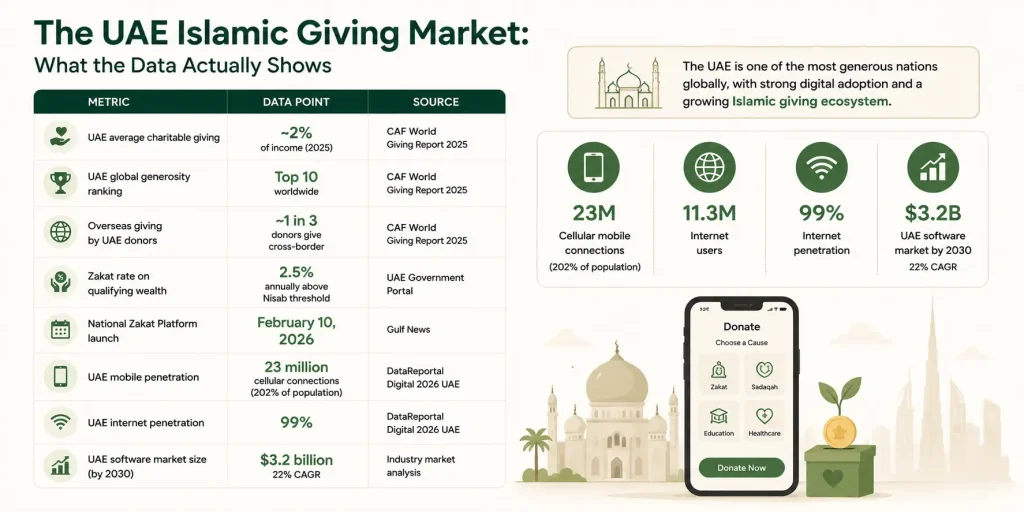
The UAE Islamic Giving Market: What the Data Actually Shows
| Metric | Data Point | Source |
|---|---|---|
| UAE average charitable giving | ~2% of income (2025) | CAF World Giving Report 2025 |
| UAE global generosity ranking | Top 10 worldwide | CAF World Giving Report 2025 |
| Overseas giving by UAE donors | ~1 in 3 donors give cross-border | CAF World Giving Report 2025 |
| Zakat rate on qualifying wealth | 2.5% annually above Nisab threshold | UAE Government Portal |
| National Zakat Platform launch | February 10, 2026 | Gulf News |
| UAE mobile penetration | 23 million cellular connections (202% of population) | DataReportal Digital 2026 UAE |
| UAE internet penetration | 99% | DataReportal Digital 2026 UAE |
| UAE software market size (by 2030) | Projected $3.2 billion, 22% CAGR | Industry market analysis |
The UAE had 23.0 million cellular mobile connections in late 2025, equal to 202% of the population, along with 11.3 million internet users and 99% internet penetration — meaning your Shariah-compliant donation app isn’t competing for attention on a device your donor doesn’t have. It’s competing on trust, speed, and compliance, in a market where donors already use polished banking and government apps daily. This is exactly why demand for professional donation app development UAE partners has grown alongside the country’s broader fintech and Islamic finance sector.
Step 1: The Legal Groundwork You Cannot Skip
Before a single wireframe gets drawn, every Islamic charity app development project in the UAE needs to clear four regulatory layers. Skipping this step is the #1 reason charity apps get pulled from app stores or blocked by payment processors mid-launch.
1. Fundraising Permits (Federal Law No. 3 of 2021)
Federal Law No. 3 of 2021 regulates fundraising activities and donations for charities in the UAE, applying to any association that wants to collect or provide donations in the country, on the mainland and in free zones. Fund-raising, whether carried out through traditional or digital methods, is restricted to entities legally classified as charitable and humanitarian organisations.
- Dubai: requires an IACAD (Islamic Affairs and Charitable Activities Department) permit. Dubai campaigns must follow IACAD-approved methods and partners, and digital platform approval is required alongside the fundraising permit.
- Abu Dhabi: requires a DCD (Department of Community Development) permit, and QR or digital donation flows may need separate digital platform approval, with donation boxes requiring their own NOC.
- Individuals or unlicensed organizations that raise funds without approval face imprisonment and fines up to AED 500,000.
2. Data Protection (PDPL — Federal Decree-Law No. 45 of 2021)
Your app will collect donor names, Emirates ID or passport data, payment details, and giving history — all of which fall under the UAE’s federal privacy law. Any platform collecting, storing, or processing personal data of UAE residents must comply with PDPL, including respecting data subject rights, providing opt-out options, and securing cross-border transfers. A 2026 addition, the Child Digital Safety Law, also imposes mandatory age verification and parental controls on platforms that may be accessed by minors — relevant if your charity runs orphan-sponsorship or education campaigns that families browse together.
3. Payment & Wallet Licensing (CBUAE)
If your app holds donor funds in-app, offers a digital wallet, or processes recurring donations, it likely falls under Central Bank of the UAE (CBUAE) oversight. Federal Decree-Law No. 6 of 2025 expanded CBUAE’s scope to cover open finance and virtual asset payments, and stored-value-facility wallet licenses can only be issued by CBUAE — not by DIFC or ADGM — for consumer-facing payment products.
4. Reporting Obligations
Charitable societies that engage in fundraising must submit reports to IACAD at the end of the fundraising period, specifying the amount of funds collected, how donations were disbursed, and expenses incurred. Your app’s backend should be built to generate these reports automatically — manual reconciliation at scale is where most compliance failures happen. If you’re mapping out every regulatory step in more depth, our Islamic charity app development guide breaks down each permit and licensing requirement in full.
Step 2: What “Shariah-Compliant” Actually Means in the Code
“Shariah-compliant” gets used loosely in marketing. In an actual Zakat app development UAE project — or any genuine Shariah-compliant donation app — it means specific, auditable technical decisions:
- Fund segregation: Zakat, Sadaqah, Waqf, and general donation pools must be technically isolated — not just labeled differently in the UI, but held in separate ledger entries so misallocation is structurally impossible.
- Nisab-based Zakat calculation: the calculator must reference the current gold/silver Nisab threshold and apply the 2.5% rate correctly across cash, gold, investments, and business assets — not a flat percentage on whatever the user types in.
- No interest (riba) on holding balances: if donations sit in an app wallet before disbursement, that balance cannot generate or be invested for interest.
- Shariah board sign-off: a certified Shariah advisor or board should review and approve the calculation logic, fund allocation categories, and permissible beneficiary categories (the eight Zakat-eligible categories under Islamic law) before launch — not just the marketing copy.
- Transparent audit trail: every donor should be able to see, at minimum, which campaign or fund their donation supports and a general status of disbursement, mirroring what the National Zakat Platform now mandates at a federal level.
Getting the calculation logic right is usually the hardest part of this step — if you’re wondering where to start, we’ve laid out how to build a Zakat calculator that’s both accurate against current Nisab thresholds and audit-ready for regulators.
Step 3: Core Features Every Islamic Charity App Needs
A well-scoped secure donation app UAE build combines Shariah-specific tools with the security and payment expectations UAE users already have from banking apps.
| Feature Category | What It Includes | Why It Matters |
|---|---|---|
| Donor onboarding | Emirates ID/passport verification, PDPL-compliant consent flows | Legal compliance + fraud prevention |
| Zakat & Sadaqah tools | Nisab-based Zakat calculator, Sadaqah/Waqf split, recurring giving | Core Shariah-compliance requirement |
| Payment gateway | Multi-currency, Apple Pay/Samsung Pay, bank transfer, card | Matches how UAE donors already pay |
| Campaign management | Verified campaign listings, real-time progress tracking | Builds donor trust, reduces support queries |
| Security layer | End-to-end encryption, biometric login, 2FA, fraud/AML screening | Protects donor data and charity reputation |
| Reporting & compliance | Auto-generated IACAD/DCD reports, audit logs | Reduces regulatory risk at scale |
| Arabic/English RTL support | Full bilingual, right-to-left layout | Standard expectation for UAE users |
| Notifications | Ramadan/Dhul Hijjah giving reminders, receipt automation | Drives recurring donations |
This is the baseline. For a fuller breakdown of which of these are must-haves versus nice-to-haves depending on your charity’s size, see our dedicated piece on Islamic charity app features.
Step 4: Security Architecture — Where Trust Is Won or Lost
Security is the backbone of any credible secure donation app UAE project — it’s the thing that determines whether a donor gives once or gives for years. And in the Islamic giving space specifically, trust has been publicly tested before.
A widely discussed critique of a major global Zakat crowdfunding platform pointed out that its “Zakat-verified” label didn’t reflect actual scholarly vetting of each campaign, and that the platform’s own terms disclaimed responsibility for verification — leaving donors to assume a level of oversight that wasn’t really there. That kind of gap is exactly what UAE regulators are now trying to close with mandatory permits and the National Zakat Platform, and it’s exactly what your app’s architecture needs to avoid replicating.
Non-negotiable security elements:
- End-to-end encryption for payment data and personal information, both in transit and at rest.
- Biometric authentication (Face ID/fingerprint) for login and high-value transactions.
- Real campaign verification workflows — not a badge, but a documented approval chain tied to your IACAD/DCD permit and Shariah board sign-off.
- AML/fraud screening on large or unusual donation patterns, in line with CBUAE and Federal Law No. 3 of 2021 anti-exploitation provisions.
- PDPL-compliant breach notification protocols — the UAE Data Office must be notified immediately in case of a data breach.
We go deeper into how to establish this kind of credibility with both donors and regulators in our guide to building trust in Islamic charity app development.
Real Examples of Islamic Charity App Development from the UAE Market
Sharjah Charity International recently launched a mobile app offering six ways to pay Zakat Al-Mal, including a built-in calculator. The calculator helps donors determine the exact payable amount based on the value entered, ensuring accuracy in accordance with Islamic Sharia guidelines. The app is backed by direct bank transfer options with Dubai Islamic Bank, Sharjah Islamic Bank, and Abu Dhabi Islamic Bank, plus Apple Pay and Samsung Pay support — a practical template for how a regional charity app should combine calculation accuracy with familiar local payment rails.
The National Zakat Platform (federal, launched February 2026) is the clearest signal yet of where the market is headed: it lets donors track project progress, monitor spending, and see how funds are allocated, helping ensure contributions reach eligible beneficiaries. Any private charity app built in the UAE from here on should assume donor expectations — and regulatory scrutiny — will match this standard.
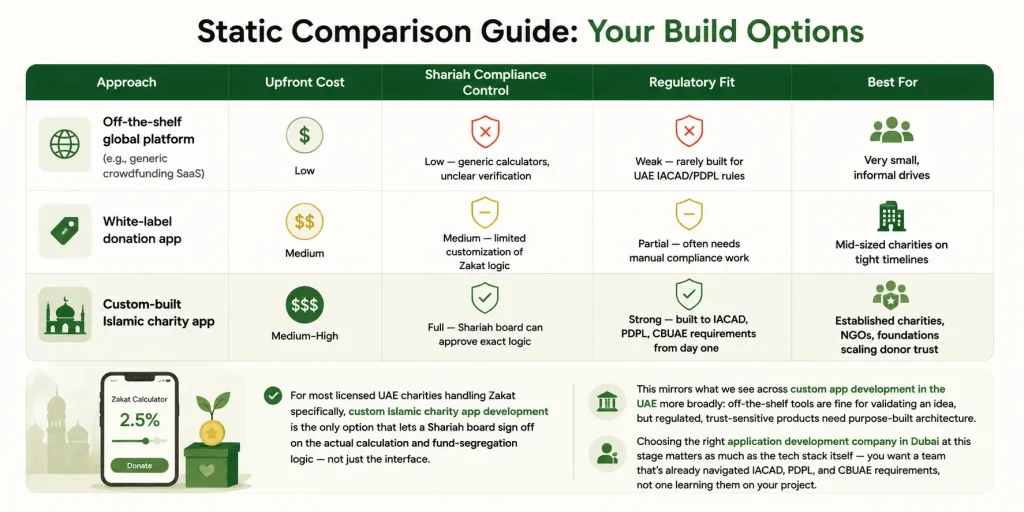
Static Comparison Guide: Your Build Options
| Approach | Upfront Cost | Shariah Compliance Control | Regulatory Fit | Best For |
|---|---|---|---|---|
| Off-the-shelf global platform (e.g., generic crowdfunding SaaS) | Low | Low — generic calculators, unclear verification | Weak — rarely built for UAE IACAD/PDPL rules | Very small, informal drives |
| White-label donation app | Medium | Medium — limited customization of Zakat logic | Partial — often needs manual compliance work | Mid-sized charities on tight timelines |
| Custom-built Islamic charity app | Medium–High | Full — Shariah board can approve exact logic | Strong — built to IACAD, PDPL, CBUAE requirements from day one | Established charities, NGOs, foundations scaling donor trust |
For most licensed UAE charities handling Zakat specifically, custom Islamic charity app development is the only option that lets a Shariah board sign off on the actual calculation and fund-segregation logic — not just the interface. This mirrors what we see across custom app development in the UAE more broadly: off-the-shelf tools are fine for validating an idea, but regulated, trust-sensitive products need purpose-built architecture. Choosing the right application development company in Dubai at this stage matters as much as the tech stack itself — you want a team that’s already navigated IACAD, PDPL, and CBUAE requirements, not one learning them on your project.
What It Actually Costs to Build One (2026 UAE Pricing)
Zakat app development UAE costs follow the broader Dubai app market: pricing typically ranges from AED 30,000 to AED 400,000+, depending on complexity and features, with backend and core development consuming 25–35% of the total budget. Apps in regulated sectors — which a licensed Zakat/donation app qualifies as — can see costs increase by 30–50% due to compliance, security, and data protection requirements.
| Build Tier | Estimated Cost (AED) | What’s Included |
|---|---|---|
| Basic MVP | 30,000 – 80,000 | Single platform, core donation flow, basic Zakat calculator |
| Mid-tier charity app | 80,000 – 200,000 | iOS + Android, campaign management, PDPL-compliant onboarding, Arabic/RTL |
| Enterprise / regulated platform | 200,000 – 400,000+ | Full compliance architecture, CBUAE-ready payment integration, AML screening, audit reporting |
Localization is essential for the UAE, where Arabic and English support is standard, and over 60% of new Dubai apps are now built cross-platform to optimize costs and reach. Annual maintenance typically adds another 15–25% of the original build cost, which charities should budget for from year one rather than treating as a surprise. For a fuller cost breakdown by individual feature, see our dedicated guide on the cost to build an Islamic charity app.
Step-by-Step Development Roadmap
Here’s the practical sequence we follow for Islamic charity app development projects in the UAE, from permit to launch:
- Secure your fundraising permit (IACAD or DCD) before development starts — this shapes what your app is legally allowed to do.
- Engage a Shariah advisory board to review Zakat/Sadaqah logic, fund categories, and beneficiary eligibility rules.
- Define your payment and compliance architecture — decide early if you need a CBUAE wallet license or can operate through a licensed payment processor instead.
- Design for trust, not just usability — verified campaigns, transparent tracking, and clear fund-use reporting should be visible in the core donation flow, not buried in settings.
- Build with PDPL-by-design — data mapping, consent flows, and breach protocols from the first sprint, not retrofitted later.
- Test the Zakat calculator against real Nisab thresholds with your Shariah board before public release.
- Launch, then report — build your IACAD/DCD reporting requirements into the backend so compliance reporting is automatic, not a quarterly scramble.
Choosing the Right Development Partner
Compliance should be treated as architecture from day one, not retrofitted after launch — that means an application development company in Dubai with hands-on experience navigating IACAD/DCD permit workflows, PDPL-compliant data handling, and CBUAE-aligned payment integration, with Arabic/English RTL support built in from the start rather than added later. Whether you’re scoping a Shariah-compliant donation app for Zakat and Sadaqah, or a full donor-management ecosystem, the right partner should be able to walk you through a realistic timeline and cost estimate based on your charity’s specific licensing status before writing a single line of code.
Final Thoughts
A Shariah-compliant donation app isn’t won on design polish — it’s won on trust, and trust in the UAE now runs through regulators, not just donor reviews. Get the IACAD/DCD permit, the Shariah board sign-off, and the PDPL-compliant architecture right from day one, and the rest of the build becomes execution, not risk.
The charities that get this right in 2026 will be the ones donors and regulators both point to as the standard — not the ones scrambling to retrofit compliance after launch.
Frequently Asked Questions
How do I know if a Zakat or charity app is actually trustworthy?
Look for a valid IACAD or DCD fundraising permit, a named Shariah advisory board, and visible fund-tracking. A vague “verified” badge with no disclosed criteria is a red flag.
Can a donation app hold Zakat funds in a digital wallet before distributing them?
Yes, but the balance can’t earn interest (riba). Depending on your setup, holding donor funds may also require a CBUAE stored-value-facility license, not just a payment processor agreement.
Does a small charity really need a custom-built app, or is white-label enough?
White-label works for short-term drives, but it rarely lets a Shariah board approve the exact Zakat and fund-segregation logic. Charities collecting Zakat specifically need custom compliance control.
How long does it take to build a compliant Islamic charity app in the UAE?
A basic MVP takes 8–12 weeks. A mid-tier or enterprise platform with full compliance, multi-payment integration, and Shariah board review usually takes 4–7 months, run in parallel.